
Introduction: A Unified Call for Awareness and Action
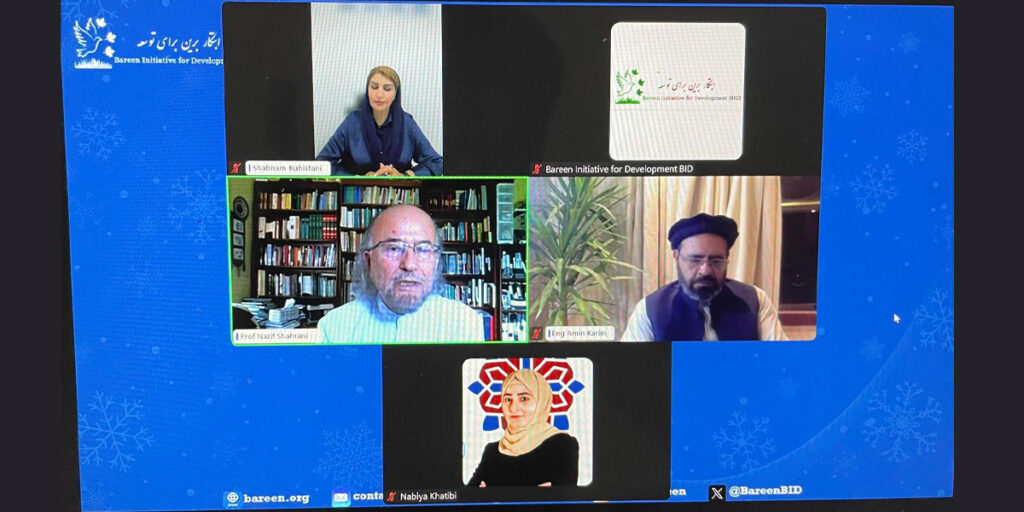
On June 14, 2025, the Bareen Initiative for Development (BID), hosted a webinar featuring university professors, civil society activists, youth, and prominent political figures. This event was a concerted effort to explore the phenomenon of extremism and propose strategies for building resilient and informed communities capable of countering ideological threats. Extremism is no longer confined to religious or geographical boundaries; it has evolved into a global phenomenon that leverages modern tools to target social structures. This seminar sought to unite the voices of intellectuals and experienced individuals to chart a path toward a more peaceful and democratic future.
Program Details: A Global Call to Action
Within the framework of the international webinar titled Countering Extremism: Fortifying Communities Against Ideological Peril, organized by the Bareen Initiative for Development (BID), this virtual gathering aimed to foster a profound and multifaceted dialogue on the roots of extremism and its political, cultural, psychological, and social consequences. The program, conducted with structure, dynamism, and transnational participation, created a platform to amplify the voices of the marginalized and those with lived experiences in Afghanistan. Live-streamed across multiple communication platforms, the event facilitated connections among Afghan citizens, human rights activists, and the global community. This convergence of perspectives and experiences transcended geographical boundaries, becoming a conduit for amplifying the demands for justice, human dignity, and peace. Beyond political analysis, the program delved into deeper themes such as identity, meaning, hope, and the restoration of social trust—elements often exploited by extremist movements. This collective effort underscored that extremism cannot be curbed through security measures alone; it must be eradicated at its roots through awareness, dialogue, and human engagement.
Panel Discussion: A Unified Voice for Awareness and Action
The webinar transcended a mere analytical session, transforming into an intellectual and ethical forum for rethinking the foundations of extremism. Three speakers, with diverse yet aligned perspectives, provided a multidimensional view of the issue: Professor Nazif Shahrani attributed extremism to colonial interventions and the misuse of religion in political spheres; Ms. Nabia Khatibi emphasized the role of social exclusion, discrimination, and lack of justice in fueling extremism; and Engineer Amin Karim described extremism as a global, multifaceted project, warning that technology, without mindful management, could perpetuate it. Mrs. Shabnam Kohistani, a civil society and human rights activist, moderated the session with professionalism and precision, fostering a respectful and sensitive environment. By posing deep and thought-provoking questions, she created a space for effective dialogue and foundational analysis.
Speakers
- Professor Nazif Shahrani – Indiana University
With a historical and analytical approach, Professor Shahrani examined the roots of extremism in colonial policies, governmental inefficiencies, and structural inequalities within the global system. He stressed that extremism does not inherently stem from religion but rather from power-driven political manipulations targeting vulnerable communities. - Ms. Nabia Khatibi – University Lecturer
Focusing on the social and psychological dimensions of extremism, Ms. Khatibi explored issues of social exclusion, structural discrimination, and identity crises. She advocated for rebuilding justice-oriented discourse, empowering women and youth in decision-making processes, and using media responsibly to counter extremist narratives. - Engineer Amin Karim – Prominent Politician and Activist
Concentrating on geopolitical and security challenges, Engineer Karim framed extremism not only as a religious issue but as a political project aimed at dominating resources and societies. He called for a national and regional front to resist extremist movements and emphasized the importance of national unity in addressing this crisis.
Content Analysis of the Speeches
In the first segment, Professor Nazif Shahrani offered a critical analysis of international policies, attributing the roots of extremism to colonial interventions and their resulting crises. He argued that religions are not inherently violent; rather, the misuse of religion within power and political frameworks fuels violence. He highlighted the September 11 attacks as a turning point in the proliferation of anti-Islamic policies and critiqued the U.S. role in commodifying extremism for political and military purposes. Ms. Nabia Khatibi, focusing on the social dimensions of extremism, addressed the issue of “social exclusion.” Citing the 2020 Strategic Dialogues Report, she noted that injustice, ethnic discrimination, poverty, migration, and marginalization create fertile ground for extremism. She argued that the lack of justice in distributing opportunities and political participation drives youth toward radical groups. Engineer Amin Karim, drawing on his personal and political experiences, warned that extremism is not limited to religious groups. He provided examples from India, Israel, Europe, and the U.S., illustrating that extremism manifests in far-right, racist, and ideological forms. He described digital platforms as tools that, instead of curbing extremism, sometimes amplify it.
Proposed Strategies and Conclusion:
The second part of the webinar focused on identifying strategies to empower communities, particularly in Afghanistan, to combat extremism. Key recommendations included:
- Promoting intercultural and interreligious dialogues to eliminate prejudices.
- Empowering women and youth through education, political participation, and media engagement.
- Supporting mental health and creating inclusive social spaces to restore public trust.
- Addressing economic and social inequalities and ensuring justice in resource and opportunity distribution.
- Utilizing technology and digital platforms responsibly to promote counter-extremism narratives.
- Preventing governments from exploiting extremism for political and geopolitical interests and ensuring the neutrality of communication platforms.
- Referencing the 2023 Moonshot Report, which highlighted that targeted interventions in virtual spaces can reduce access to extremist content by up to 40%, positioning technology as an opportunity for awareness rather than a threat.
Conclusion
This webinar marked a significant step toward rethinking how to counter extremism on intellectual, structural, and social levels. The contributions of each speaker underscored that Afghan society, despite immense pressures, remains vibrant, resilient, and ready for change. While challenges abound, solutions are within reach, provided the voices of women, youth, and intellectuals are heard and genuine opportunities for participation are created. A just future is attainable only through awareness, dialogue, justice, and civic resistance.
Concept Note English
Concept Note Persian
Reports English
Report Persian