
Introduction: Valuing Spirituality
On May 16, 2025, the Bareen Initiative for Development (BID) hosted the second series of the Bareen Democracy Forum titled “Hope in Spiritual Hunger: A Critique of the Taliban’s Approach and the Centrality of Metaphysical Needs in Afghanistan.” The most pressing issue in Afghanistan today remains the critique of the Taliban’s policies and the fragility of the Afghan people’s spiritual needs. What is at stake in Afghanistan is not only access to food and freedom but also the hope, spirit, and spirituality of its people, which are under severe threat. The Taliban, through their efforts to control and suppress, have taken the nation’s spirituality hostage.
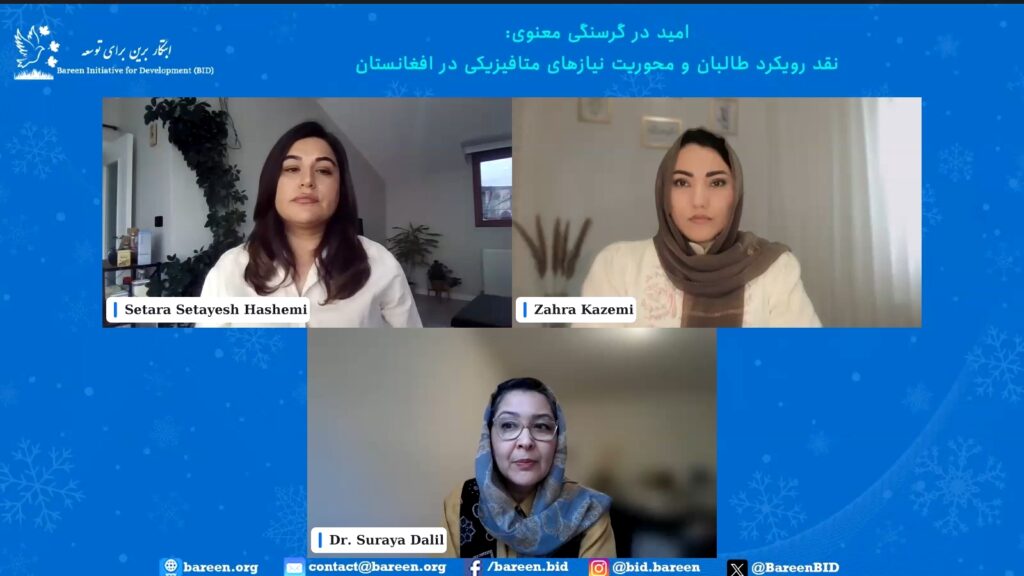
The event aim was to challenge the threats posed by the Taliban and highlight the power of spirituality and metaphysical ideas among the Afghan people. Spiritual famine is far more dangerous than material poverty. To address these challenges without relying on ineffective external factors, resistance against Taliban domination is essential.
This session critically examined the Taliban’s approach to religion and spirituality, emphasizing the necessity of addressing the metaphysical and spiritual needs of the Afghan people as a key to resolving social and political crises.
Program Details: A Global Call to Action
The event “Hope Amid Spiritual Hunger: A Critique of the Taliban’s Approach and the Centrality of Metaphysical Needs in Afghanistan” was conducted dynamically, live, and with purposeful design to forge connections between the Afghan people and their global supporters through multiple communication platforms.
The event was structured to foster effective dialogue between the Afghan populace and the international community. Broadcast live, it transcended borders, resonating globally with voices from afar.
Panel Composition: Courage, Wisdom, and Inspiration
The panel featured distinguished speakers:
- Ms. Setara Setayesh Hashemi, a journalist who kept the discussion vibrant with her insightful questions.
- Dr. Suraya Dalil, former Minister of Public Health and Afghanistan’s former Ambassador to Geneva.
- Ms. Zahra Kazemi, a political analyst and head of the Women’s Council of the National Resistance Front of Afghanistan.
These individuals were not only exceptional speakers but also brought profound insights into the spiritual needs of Afghan society, offering valuable perspectives and solutions.
Key discussion theme:
Afghanistan today faces spiritual hunger and metaphysical disconnection, driven by the Taliban’s misuse of religion, suppression of freedoms, and erosion of human dignity. This program aimed to critique the Taliban’s approach while underscoring the need to revive hope, rebuild individual and collective spirituality, and emphasize the role of women and youth in shaping a just and humane future.
Spiritual Hunger and Social Disconnection in Afghanistan
Dr. Suraya Dalil eloquently stated that every society rests on fundamental pillars:
- Law: The constitution serves as the cornerstone of all laws, shaping social, cultural, and legal frameworks. These laws could empower and preserve a society’s spiritual values.
- Institutions: Public and governmental institutions are responsible for delivering public services, including legislative bodies, public representation, and oversight mechanisms. Academic and research institutions also play a critical role in fostering intellectual growth and developing skilled human resources.
- Cultural Foundations: A society’s history, literature, art, poetry, music, and other creative expressions are core components of its spiritual identity.
The Afghan people embody the soul and identity of the nation. Years of elite migration and the rise of extremism have weakened the country’s intellectual foundations[SD1] . Nevertheless, Afghan women, particularly those who are educated and resilient, stand as torchbearers of resistance and hope, keeping the nation’s spirituality and future alive.
The Taliban’s Approach to Religion and Spirituality
Ms. Zahra Kazemi highlighted that the Taliban’s ideology is not only anti-science and anti-women but also fundamentally opposed to the spirit of Islam and human dignity. Their restrictive and extremist interpretation of religion has suppressed education and awareness, particularly women’s education, which is the foundation of societal transformation. These policies have created an identity crisis and intellectual disruption in the country.
The Taliban fear an enlightened society, knowing that awareness spells the end of their dominance. Closing schools, silencing women, and imposing rigid doctrines are part of a deliberate effort to undermine the Afghan people’s spirituality and resolve.
In response, Afghan women and youth have emerged as beacons of hope and resistance. Through awareness, resilience, and civic activism, they have sustained an anti-Taliban discourse. However, success requires unity among diverse ethnic groups and societal segments, reliance on the younger generation, and genuine—not superficial—global support. Only through solidarity and awakening can Afghanistan’s identity, spirituality, and future be restored.
The demands of the Afghan people are universal, legitimate, and rooted in social realities, not individual whims. Every anti-Taliban movement echoes the resilient and hopeful voice of the people.
Yet, Afghan society suffers from a crisis of trust. The Taliban’s suppression of culture, language, and identity has led to frustration and disorientation. The destruction of culture erodes hope, ultimately leading to resignation.
The solution lies in returning to education, awareness, and grassroots dialogues that emerge from the people and shape the future. Afghans must recognize their agency as the true owners of their homeland. Change is possible only when people believe in their role in building the future.
The salvation of Afghanistan lies in collective awareness, active participation, and the reclamation of cultural and political identity.
The Need for Mental Health and Spirituality in Afghanistan’s National Reconstruction
Dr. Suraya Dalil emphasized that to address societal challenges, they must first be accurately defined. In Afghanistan today, hope, identity, and intellectual values should not be treated as luxuries but as essential components of survival and development. These values become embedded in society when they are central to political and social discourse.
Governments bear the fundamental responsibility of safeguarding national identity, cultural values, and citizens’ rights. However, in Afghanistan, the distortion of the concept and practice of governance and use of religion as an instrument for oppression have distanced people from true Islamic and humanity values. In the absence of a responsible elected government, a significant void has emerged in cultural, social, and psychological domains that civil movements alone cannot fill.
While the role of the international community is important, over-reliance on external aid is not a solution. The path forward lies in awareness, self-belief, and public participation. At the same time, basic needs such as food, healthcare, and security cannot be overlooked, as discussing spirituality could become less important in a country where mothers die due to lack of resources.
Beyond natural and social crises, Afghanistan’s healthcare system faces severe weaknesses. Mental health, particularly for women and youth, demands urgent attention. Postpartum depression, addiction, and trauma-related disorders from war and violence require dedicated resources programs. Mental health must be integrated into medical education, with female healthcare workers trained to provide diagnostic, therapeutic, and counseling services at the primary level.
Programs such as group therapy and community counseling should be expanded. Female healthcare workers play a vital role in community health, as Afghan women often prefer to seek care from other women.
Ultimately, Afghanistan’s reconstruction requires a responsible government, public participation, attention to mental and physical health, and the revival of cultural and spiritual identity. Only through collective effort, education, and awareness can hope be restored.
Centrality of Spiritual Needs in Afghanistan’s Reconstruction
Dr. Suraya Dalil emphasized the importance of returning to human and spiritual values, promoting peace and empathy, and creating space for freedom of thought and spiritual education. Prioritizing mental health, supporting women and youth, and establishing independent cultural institutions free from politics were highlighted as key strategies.
The Necessity of a Future Government
The discussion addressed Afghanistan’s deep political and social challenges, stressing the importance of genuine and equitable participation of ethnic groups, women, and youth in decision-making. Over-reliance on foreign aid is not a solution and may perpetuate crises. The international community’s lack of prioritization of Afghanistan’s issues was noted, despite some efforts by human rights and women’s advocacy organizations. The absence of a legitimate government has diminished Afghanistan’s global voice and advocacy opportunities.
Nevertheless, hope for a free future and national reconstruction based on human dignity, cultural identity, and spiritual needs remains a bright prospect. A future government must genuinely represent all ethnic groups, women, and youth—not merely symbolically. Laws must be implemented, and past experiences show that excluding youth and depending on foreign support led to failure and collapse.
The path forward requires a profound re-evaluation of governance structures, strengthening national and regional consensus, and addressing the spiritual, human, and material dimensions of society. This path is achievable only through the Afghan people’s collective effort, hope, and awareness.
Strategies for Sustaining Hope and Resistance at Individual and Collective Levels
To maintain hope and unity, Afghanistan must first establish a broad national consensus inclusive of women and youth, followed by a regional consensus that considers the interests of neighbouring countries. The focus should not solely be on negotiating with the Taliban but on planning for a post-Taliban era. The future system must be just, truly representative, with free media and principled leadership. The younger generation must be at the forefront of this transformation. This is a historic opportunity to build a different future, with Afghans actively and consciously participating in decision-making to realize a free Afghanistan.
Practical Proposals to Combat Spiritual Hunger
Dr. Suraya Dalil stressed that sustaining hope, particularly among Afghan girls, is key to individual resilience. Education and learning, even in difficult circumstances, serve as forms of resistance and even growth. At the collective level, families—especially fathers—play a crucial role. Supporting, respecting, and involving girls in decision-making must be practiced and institutionalized at home to end cultures of violence and humiliation. A society that views women with dignity at home, directly contributes to building an empowered and aware community. Every individual, through their actions and beliefs, can contribute to this transformation and a better future for Afghanistan.
Participants proposed expanding educational and psychological programs, fostering a free media environment, supporting civil and cultural organizations, and creating platforms for dialogue among diverse ethnic and social groups. Additionally, the international community must respect Afghanistan’s independence while supporting human rights and fundamental freedoms.
Scientific and Strategic Conclusion
The “Hope Amid Spiritual Hunger” program demonstrated that Afghanistan’s current crisis is multidimensional, with its spiritual and psychological dimensions as critical as its political and economic challenges. The Taliban’s authoritarian and suppressive approach to religion has intensified spiritual hunger, leading to distrust and diminished hope within society.
For a genuine and sustainable reconstruction of Afghanistan, the metaphysical needs of the people—particularly hope, mutual trust, and mental health—must be central to policymaking and cultural programs. A future government should:
- Be inclusive, just, and a true representative of all ethnic groups, women, and youth;
- Be rooted in human, spiritual, and fundamental freedoms;
- Strengthen mental health and spirituality within healthcare, education, and societal systems;
- Foster a free media environment and civil discourse;
- Leverage international support to advance human rights.
This vision requires collective awakening, education, and effort to restore hope and rebuild Afghanistan’s future.
Concept Note English
Concept Note Persian
Report English
Persian Report