Introduction
Afghanistan’s modern history has been shaped by a periodic pattern; ambitious efforts to build a national army are followed by collapse, state fragmentation, and renewed dependencies on foreign sponsors. From President Daoud Khan’s 1973 coup to the Taliban’s return in 2021, successive governments expanded military forces under foreign patronage – only to see them collapse once external financial and logistical lifelines were stopped. This analytical article traces Afghanistan’s military cycles, from Daoud Khan’s first republic, the People’s Democratic Party of Afghanistan (PDPA) communist regime, the Mujahideen/Taliban 1990s civil war, and the U.S.-backed Islamic republic, and Taliban II. It identifies recurring weaknesses, compares Afghanistan’s trajectory with regional peers that have built stability through infrastructure investment, and consider lessons for future reforms.
Historical Evolution of Afghanistan’s Military
- Daoud Khan Era (1973-1978)
On 17 July 1973, while King Zahir (Zahir Shah), the last king of Afghanistan, was abroad, Mohammad Daoud Khan, then-army commander, seized control of Kabul following a military coup against the monarchy, ending nearly four-decades of monarchy declaring Afghanistan’s first republic. Daoud called the coup a “national and progressive revolution” and then declared himself the first president of Afghanistan. Daoud modernized and expanded the army, creating new officer training facilities and boarding schools to detach the army from tribal influence. The army grew significantly, drawing on Soviet equipment and advisors. However, Daoud’s crackdown on political opponents, especially senior PDPA cadres, provoked intense factional tension. In April 1978, PDPA elements in the army staged the Saur (April) revolution, killing Daoud and seizing power.
- PDPA Era (1978-1992)
The PDPA government (1978-1992), split between Khalq and Parcham factions, expanded the military with soviet funding and equipment. The paper figure exceeded 300,000 troops, while the actual strength was far lower. RAND corporation analysis shows the Afghan army averaged only 53 percent of its authorized manpower by the late 1980s, with many units at only 25-40 percent strength. Internal factionalism further weakened the force. Mass desertions were common, and morale was poor. By the late 1980s, army specialists and officers were underfilled, and many had not completed formal training. When the Soviets withdrew in 1989, President Najibullah relied on ethnic militias (mainly in the north) for survival, but they were not reliable. Najibullah’s government fell in 1992 amid civil war, as the centralized army collapsed into militias and warlord armies.
- Civil war and Taliban I (1992-2001)
From 1992 to 1996, Afghanistan fractured into rival Mujahideen fiefdoms. The Taliban emerged from Kandahar in 1994, promising order, and captured Kabul in 1996.the military was highly motivated and ideologically unified but lightly equipped, with no deep logistical infrastructure. By late 2001, U.S.-led coalition airpower and local opposition (Northern Alliance) shattered the Taliban army, which had little air defense or logistics. As one NATO spokesman noted, the Taliban “simply do not have the manpower, capability, or coherence in command and control” to constitute a sustainable state military.
- Islamic republic/NATO era (2001-2021)
Following the collapse of the Taliban I regime, a new Afghan National Army (ANA) and police force were established with U.S./NATO support. By the mid-2010s, these forces numbered approximately 350,000 troops and officers, supported by over $90 billion from the U.S. and international community. Despite this extensive investment, ongoing issues undermined their effectiveness. “Ghost soldiers” (fake recruits on payrolls) and widespread corruption inflated official figures and drained resources. Furthermore, the ANA continued to depend on coalition air support, logistics, and maintenance that Afghan institutions could not sustain independently. When U.S. forces withdrew in 2021 following the Doha agreement with the Taliban, these vulnerabilities proved fatal: the Afghan military rapidly lost cohesion and disintegrated.
- Taliban II (2021-2025)
Since regaining power post August-2021, the Taliban have maintained an estimated 150,000 – 175,000 army combined (conventional units and internal security forces). Their military is cohesive in ideology but lacks the heavy weapons, and air power.
| Era / Year | Reported Strength | Estimated Actual Strength | Reliability of Figures |
| Daoud Khan (1978) | 90,000 | 90,000 | High |
| PDPA Peak (1988) | 160,000 | 101,500 | Low |
| Karzai era Start (2003) | 49,000 | 49,000 | High |
| NATO Peak (2015) | 350,000 | 252,000 | Low |
| Final ANDSF (2020) | 165,000 | 165,000 | Moderate |
| Taliban II (2024 est.) | 175,000 | 175,000 | Moderate |
Table 1: Reported vs. Actual Afghan Military Strength (1978–2024)
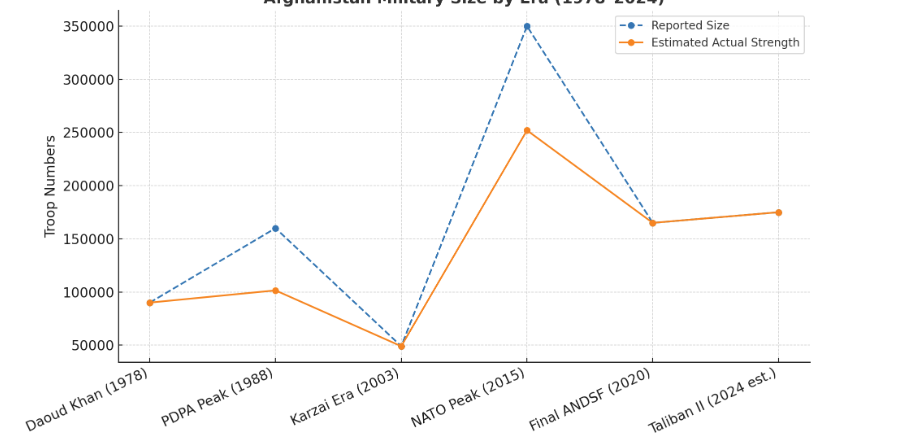
Figure 1: Figure 1 – Afghan Military Size by Era (1978–2024)
Root causes of Military Collapse
Across all regimes/governments, three systematic weaknesses repeatedly undermined Afghanistan’s military establishments:
- External dependences: Armies were built around foreign support. The Daoud regime depended on Soviet arms and advisers, and the post-2001 ANA on U.S./NATO assistance. When these external props vanished, Afghan forces quickly disintegrated.
- Corruption and ghost soldiers: systematic graft inflated forces size on paper while starving real units of manpower and supplies. For example, investigations found that only 254,000 of 352,000 reported ANDSF members could be confirmed on duty (28 percent) ghosted. Pay and equipment meant for rank-and-file soldiers were routinely stolen, eroding morale and effectiveness.
- Weak institutions: Afghan militaries’ internal systems were not functioning as intended. Command structures were top-heavy and politicized, while logistical, training, and maintenance were underdeveloped. Promotions often reflected patronage, and there was little emphasis on sustainable domestic industry or supply chains. In short, there was no institutional resilience to survive shock like leadership change or withdrawal of aid.
Regional comparison: infrastructure and Stability
By contrast, neighboring countries leveraged relative political stability to build economic infrastructure:
- Pakistan: $60 billion China-Pakistan economic corridor (CPEC), funding highways, railways, and energy projects connecting China to the Arabian sea. These projects strengthen Pakistan’s role in global supply chain.
- Iran: Completedthe 225kmKhaf-Herat railway, (140km in Afghanistan, 85km in Iran), the first rail link from Iran into western Afghanistan.
- China: the Belt and Road initiative (BRI) has mobilized over $1 trillion in global infrastructure investment in the past decade, trying together networks across Asia and beyond.
- Turkmenistan: Continues to pursue the 1,814km TAPI gas pipeline through Afghanistan, Turkmenistan, Pakistan, and India, although construction has been slow and plagued by security and finance hurdles.
These projects reflect long-term state planning and continuity of governance. By integrating into regional transport and energy networks, these countries have boosted economic stability. Afghanistan, by contrast, remains mired in conflict and underdeveloped, for instance, ever after conflict half of Afghans live in poverty. Chronic insecurity and governance breakdown have repeatedly derailed projects that could have improved resilience.
Lessons for Afghanistan (and development gap): A Key lesson is that external support no substitute for internal cohesion and self-reliance. As Cordesman warns, “no outside power can help a failed government that cannot help itself”. Decades of war showed that without a unified, inclusive government and trustworthy institutions, foreign aid and armaments will ultimately collapse. The experience suggest Afghanistan must build abroad domestic legitimacy, fight corruption, and invest in its own capabilities rather than over-rely on others. Today Afghanistan remains one of the world’s poorest and least-development countries. With low human development index (HDI) of 0.46 in 2022, rank 182 out of 189 countries, far beyond neighbors (for comparison Uzbekistan HDI is 0.73 and Iran’s 0.78). The economy is weak, poverty is rampant, and many Afghans lack basic services. By contrast, countries that avoided protracted war have achieved much higher living standards. In summary, Afghanistan’s decades of conflict left it dramatically “behind” its neighbors in development (low GDP per capita, education, health, infrastructure). The historical lesson is clear: to catch up, Afghanistan mist focus on internal reforms and stability, building its own institutions, national unity, diversified economy, rather than depending indefinitely on external patrons.
Future research question
What combination of institutional reforms and regional partnerships could best help Afghanistan build a stable, self-reliant, and inclusive military? For example, how might international investments in infrastructure or training be organized to promote transparency and meritocracy rather than fostering patronage networks? Finding the right balance between foreign aid and local capacity will be essential. Future research should examine models, possibly based on regional examples, for redesigning Afghanistan’s military to avoid past failures.
About the author:
Elham Kabir is a development professional with over a decade of experience in multiple sectors. He has led multi-million dollar humanitarian and infrastructure projects across afghanistan, working closely with INGOS, private sector and government bodies.