
Introduction
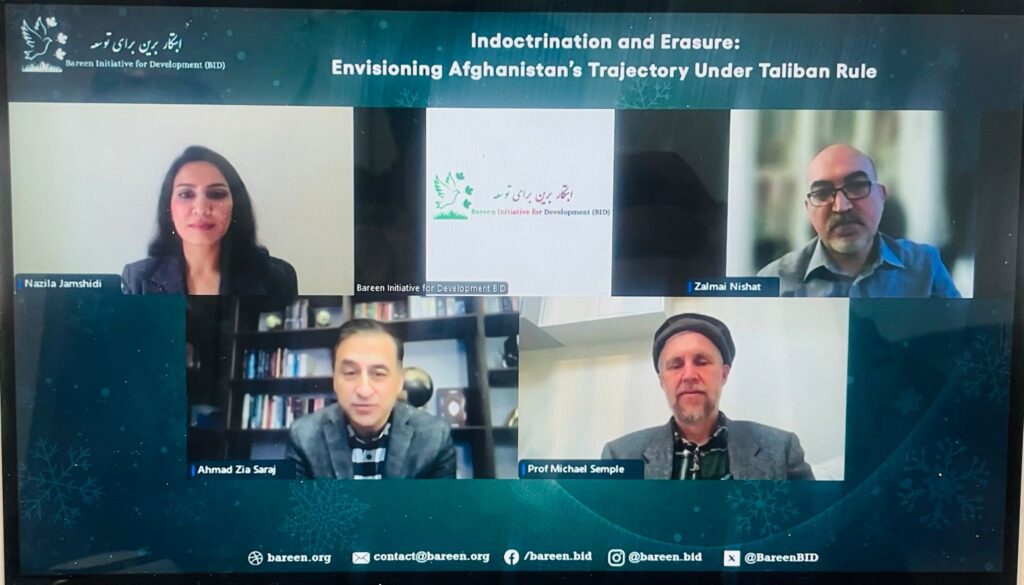
On Saturday, February 21, 2026, the Bareen Initiative for Development (BID) hosted a webinar titled “Indoctrination and Erasure: Envisioning Afghanistan’s Trajectory Under Taliban Rule.” The session brought together experts to examine the profound political, security, and social transformations in Afghanistan since the Taliban’s return to power in 2021. The main focus of the discussion was the Taliban’s deliberate strategy to reshape society—particularly through the systematic exclusion of women and the radicalization of young men—and the far-reaching consequences for national and regional stability. Panellists emphasized that the marginalization of women and the transformation of education into a vehicle for ideological indoctrination are not mere side effects of Taliban governance; they form the core of a calculated approach to consolidate and perpetuate power. The webinar issued a stark warning: as poverty deepens and an entire generation is radicalized, Afghanistan risks becoming a major source of transnational threats. Ignoring this gender apartheid, speakers argued, will carry irreversible security costs for the broader region and beyond.
Program Overview
The webinar organized as a specialized online panel by the Bareen Initiative for Development, the event delved deeply into the multifaceted crisis unfolding under Taliban rule.
- Primary Objective: To elevate strategic discourse around the medium- and long-term political, social, and security implications of women’s exclusion, the fostering of extremism through education, and practical pathways to support Afghan women’s and girls’ fundamental rights amid ongoing political deadlock.
- Core Focus: Exploring the interconnected dynamics of security, politics, and society; the links between women’s erasure, rising extremism; and strategies for restoring voice and agency to Afghan civil and political society in the post-2021 landscape.
Speakers and Moderator
- Ahmad Zia Saraj: Former Director General of the National Directorate of Security, Islamic Republic of Afghanistan.
- Professor Michael Semple: Queen’s University Belfast; former UN and EU representative for Afghanistan.
- Zalmai Nishat: Founder and Executive Chair, Mosaic Global Foundation.
- Nazila Jamshidi: Policy, gender equality and human rights specialist; moderator.
Key Insights from the Speakers:
The panel offered a rigorous dissection of Taliban policies and their repercussions across security, political, and sociological dimensions.
Ahmad Zia Saraj focused on the education crisis and the weaponization of religious schooling:
- Systematic Exclusion: More than three million girls remain barred from education—a humanitarian catastrophe that also inflicts billions in lost economic potential for the nation.
- Curriculum Overhaul: While girls are entirely removed, boys are immersed in an environment saturated with ideological messaging. Scientific subjects, arts, and critical thinking have been supplanted by extremist interpretations.
- Extremism Pipeline: The rapid proliferation of Taliban-controlled madrassas—estimated to enroll 2–3 million boys—represents one of the largest recruitment mechanisms for militant groups in recent history.
On security and regional stability
- Time bomb: Mr.Saraj described the situation as a ticking time bomb: widespread youth radicalization, combined with deepening poverty and joblessness, threatens to explode at any moment.
- Presence of terrorist groups: Terrorist organizations such as al-Qaeda and Tehrik-i-Taliban Pakistan (TTP) operate with near-impunity inside Afghanistan, posing direct risks to neighboring countries and the wider world.
- Illicit/illegal economy: These groups now fund themselves more robustly than ever through cross-border crime and exploitation of natural resources.
Zalmai Nishat addressed the cultural and linguistic dimensions of repression:
- Assault on Imagination: By restricting languages (especially Persian/Dari) and reshaping educational content, the Taliban seeks to control collective imagination and eliminate any vision of an alternative future.
- Human Capital Erosion: The removal of women and skilled professionals from public life has triggered an unprecedented cultural and intellectual decline—one that will take generations to repair.
Nazila Jamshidi, as moderator, underscored the human rights and global responsibility angles:
- Security-Education Nexus: Denying girls education is not solely a rights violation; it is a direct security threat. A society that excludes half its population while indoctrinating the other half inevitably exports instability.
- Call for Unity: She stressed the urgent need for coordinated international action and stronger solidarity within the Afghan diaspora to counter gender apartheid and bolster internal civil resistance.
Professor Michael Semple analysed Taliban engagement with the outside world:
- Deception Strategy: The Taliban has skilfully used diplomatic tools to project a reformed image—creating a narrative that facilitated the withdrawal of foreign forces.
- Financial Independence: By harnessing domestic revenues and public finances, they have reduced reliance on foreign aid, thereby weakening external leverage over their behaviour.
Conclusion
Participants unanimously framed the current Afghan situation as far more than an internal crisis or a women’s rights issue: it represents a pressing concern for national, regional, and global security. Failing to confront the realities on the ground and develop a unified regional and international strategy only strengthens the Taliban’s hand and invites long-term instability across the region and beyond. The webinar served as a sobering reminder that the policies of exclusion and indoctrination now underway are actively seeding the next generation of threats—threats that no border can fully contain.
Concept Note English
Concept Note Persian
Report English
Report Persian