
Introduction
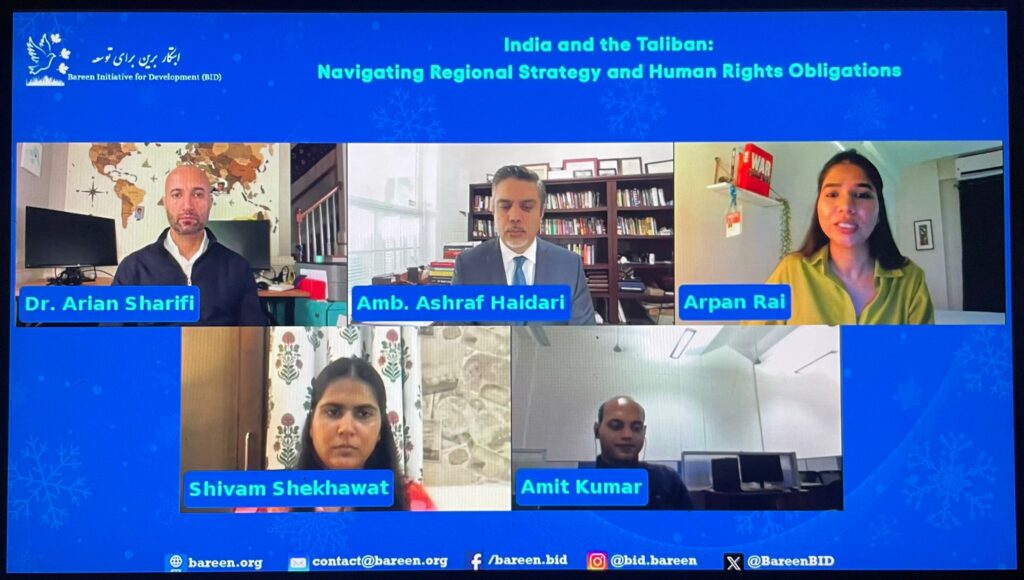
On Monday, September 15, 2025, a significant webinar titled “India and the Taliban: Navigating regional strategy and human rights obligations” was hosted by the Bareen Initiative for Development (BID). The event aimed at examining India’s cautious yet pragmatic diplomacy towards the Taliban leaders in Afghanistan. The webinar’s four segments looked at New Delhi and Kabul’s historical and strategic ties, the geopolitical implications on South Asia and beyond, the human rights and ethical challenges – especially for Afghan girls and women and policy suggestions for the future engagement, keeping the Afghan population in mind.
Program Details
As part of the international webinar “India and the Taliban: Navigating Regional Strategy and Human Rights Obligations,” organized by the Bareen Initiative for Development (BID), the event provided a platform for evidence and facts-based discussions on the pivotal shift in India’s engagement with the Taliban leaders. The move has set off a precedent in South Asia and beyond on engaging with the Taliban, which is still considered a global pariah.
With diverse experience-enriched perspectives from the speakers from both the countries, the webinar platformed the diplomatic and humanitarian aspects covering the cost of Delhi’s engagement with the hardline regime in Kabul.
Live-streamed across multiple platforms, the event facilitated dialogue among Afghan citizens, human rights activists, speakers from India and the global community. The synergy of perspectives and experiences transcended geographical boundaries, serving as a conduit for amplifying the demands for justice, human dignity, and peace. The program rigorously analysed India’s engagement with the Taliban and offered a policy framework for balancing non-negotiable regional strategic interests while fulfilling ethical responsibilities.
Panel Discussion: A Critical Analysis of Afghanistan’s Situation
The panel was composed of former diplomats, scholars, researchers and academics who have monitored India’s growing interactions with the Taliban leaders, assessed the economic and geopolitical motivations and offered suggestions on the way forward.
Key Discussion Themes:
- Historical and strategic context of India-Taliban relations
- Geopolitical implications for South Asia and beyond
- Human rights and ethical challenges
- Future scenarios and regional stability
Speakers
The panel featured distinguished speakers, including Mr. Haidari, Dr. Sharifi, Ms. Shekhawat, and Mr. Kumar, each offering unique perspectives on the issue:
- Mr. M Ashraf Haidari, former Afghanistan ambassador to India, the US and Sri Lanka and distinguished fellow at Arizona State University School of Politics and Global Studies: Highlighted the neglect of regional responsibility from India on engaging with the Taliban at the cost of millions of Afghans.
- Ms. Shivam Shekhawat, junior fellow with the ORF’s strategic studies programme: Deconstructed New Delhi’s diplomatic engagement while evaluating the perils of terrorism threats from Afghanistan, underlined Afghan women’s rights to be taken into consideration, and called for bolstering humanitarian support for Afghans.
- Dr. Arian Sharifi, former lecturer and chair of the Master in Public Policy Program at Princeton University’s School of Public and International Affairs and international affairs expert: Assessed the regional politics of outreach of the Taliban on India’s neighbours Pakistan and China, probed threat of terrorism over the past four years and called for seeking out legitimate partners in Kabul.
- Amit Kumar, senior research fellow at BITS, Pilani: Offered key takeaways of Delhi’s imperative to continue its diplomatic allyship with Afghanistan, highlighted India’s role as a good neighbour and cautioned against future threats facing Delhi from the region.
Analysis of Speakers’ Content: Perspectives and Approaches
This section provides an analytical summary of the speakers’ contributions:
Mr. Haidari’s Perspective:
- Made a special emphasis on advantages New Delhi has seen during the period of Republic government in Afghanistan, and censured the lack of bilateral help during the fall of Kabul.
- Called on the Indian government to engage Afghans in exile with several social and cultural initiatives.
- Underlined the pitfalls of the “zero sum approach” taken by New Delhi to engage with the Taliban without acknowledging the social and democratic cost of the move.
Ms. Shekhawat’s Perspective:
- Highlighted the centuries old Delhi-Kabul relationship premised on the People-to-People ties with the long-standing cultural affinities.
- Despite several humanitarian aid initiatives on visas, medicine and earthquake relief, the cost of India’s protection of its interest in Afghanistan is being borne by Afghan women.
- India should lead the way as a regional power by voicing concerns for Afghans in regional groupings and constantly recalibrate its policy as the dynamic situation develops in Afghanistan.
Dr. Sharifi’s Perspective:
- Highlighted security and intelligence sharing between India and the Afghan government for 20 years.
- Underlined that a fruitful and mutually responsible relationship between Afghanistan and India can only happen under a legitimate law-based government in Kabul. Cautioned against leaving Afghanistan in limbo.
- India’s engagement is to balance regional powers Pakistan and China’s contact with the Taliban but assessment of short-term and long-term gains is a must.
Mr. Kumar’s Perspective:
- Reiterated India’s engagement with the Taliban in line with New Delhi’s national interests and security concerns, and also align with non-interference in domestic politics of other nation states.
- Underscored the general consensus among Afghan stakeholders that the Taliban group is a geopolitical tool to protect security and development interests in the region in the current stage.
- Detailed the extent of China’s presence and control over Afghanistan and beyond (Iran, Tajikistan and Uzbekistan) under the Taliban, forcing India to expand its diplomatic footprint in the country.
Proposed Strategies and Conclusion
- Helming regional responsibility with leadership role: India should assume the role of leader as the largest democracy, reject recognition of the Taliban, continue humanitarian aid, and provide haven to Afghan talents.
- With Afghans, For Afghans and of Afghans: Increase engagement with Afghans, recalibrate bilateral policy with Afghanistan with shifting power dynamics and continue humanitarian initiatives.
- Advocacy-led diplomatic allyship: With little to no changes expected on India’s current engagement trajectory with the Taliban, Indian government should at least rally for Afghans and become a regional leader.
- Bolster Afghan economy for long-term goodwill: India should continue investing in Afghanistan’s development projects and in Chabahar port and the International North-South Transport Corridor.
- Legitimacy versus Survival: Diplomatic hiccups aside, India should continue being an economic partner to provide hundreds of thousands of Afghans with financial umbilical cord irrespective of an illegitimate regime.
Conclusion: Responsible and Ethical Diplomacy Need of the Hour
The more than two-hour long discussion on studying Delhi and Kabul’s centuries-old relationship being tested by a hardline regime resulted in varied perspectives – but all united in their concern for protecting the Afghan population under Taliban rule.
With disappointment in India’s increasing engagement with the Taliban leaders highlighted, the seminar acknowledged the diplomatic and humanitarian responsibility Delhi was expected to carry out – mainly to protect millions of Afghans. With too little done in the months after 15 August 2021, India’s cautious engagement is now in the throes of navigating ties with the UN-sanctioned group. While Russia and China remain autocracies, India is a democracy and expected to voice concerns for its Afghan neighbours who are facing an oppressive regime dismantling the basic rights of education and work for nearly half of its population of Afghan girls and women.
Granted the regional pressure to remain ahead of rivals like China and Pakistan, India’s engagement is led by its own security concerns of presence of at least 20 terrorist groups in Afghanistan being harbored by the Taliban.
However, Delhi is steadfast in nourishing its people to people ties with Afghanistan while looking out for its security concerns. As suggested rightfully by the diplomats and scholars on the panel, this engagement can be enriched and refined further by India assuming the position of a regional leader who speaks for Afghan girls and women at every stage possible in Asia and beyond.
The step will be the one of the many first corrective befitting of a regional ally and re-instill faith of Afghans counting on New Delhi.
Concept Note English
Concept Note Persian
English Report
Persian Report