
Introduction: Honouring Core Values
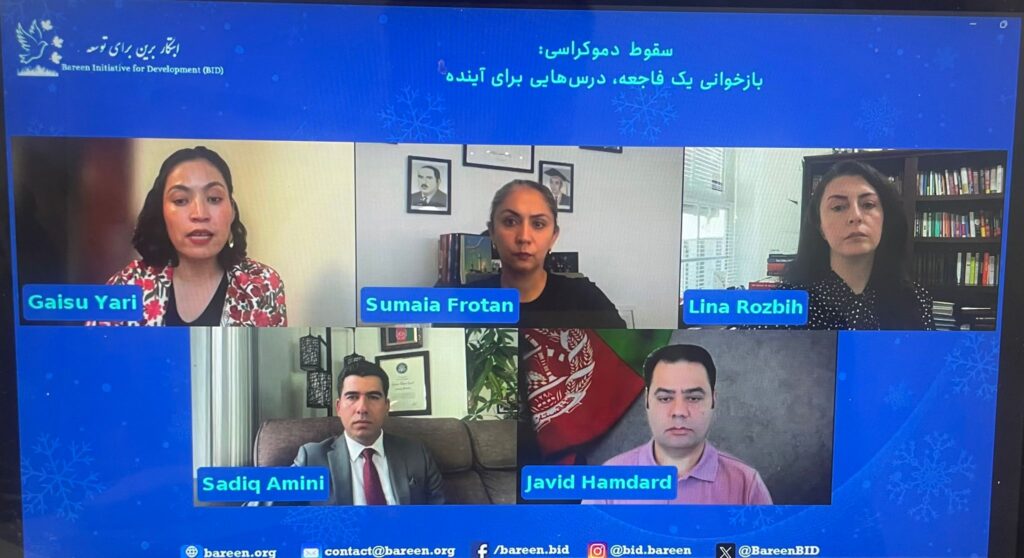
On Sunday, August 24, 2025, the Bareen Initiative for Development (BID) hosted the third series of the Bareen Democracy Forum under the title “The Fall of Democracy: Reflecting on a Tragedy, Lessons for the Future.” The event aimed to reflect on the collapse of democracy in Afghanistan and examine its implications for the country’s future. Speakers sought to critically and analytically explore not only the reasons behind this failure but also propose strategies to prevent its recurrence. The significance of the program lay in its emphasis on the necessity of revisiting the past to build a better future.
Program Details
Within the framework of the international webinar “The Fall of Democracy: Reflecting on a Tragedy, Lessons for the Future,” organized by the Bareen Initiative for Development (BID), the event sought to compile diverse narratives surrounding the collapse of democracy and the Taliban’s takeover in Afghanistan. The program was skilfully moderated, guiding discussions toward critical issues. The focus was on key questions: How realistic is the possibility of internal reform within the Taliban? What practical measures can counter their policies? What roles can the international community and the Afghan diaspora play in supporting the Afghan people? Thus, the program was not merely a recounting of events but a platform to integrate diverse perspectives and lived experiences, fostering forward-looking solutions to address the ongoing crisis.
Panel Discussion: A Multifaceted Approach
The main panel adopted a hybrid structure, with discussions unfolding in a multilayered and interconnected manner. Each speaker introduced a topic that complemented others.
- Social and Gender Dimension: The role of women in the struggle and resistance was emphasized. Women, as primary victims of the democratic collapse, are now pioneers of a new narrative of freedom. Speakers highlighted that men bear a historical responsibility toward women, having often failed to support them or even contributed to their oppression in the past.
- Political and Legal Dimension: Another segment focused on the absence of a robust legal system and the fragility of Afghanistan’s political institutions. Speakers noted that the constitution and electoral framework lacked the strength to prevent collapse. Additionally, overt and covert regional support for the Taliban deepened the crisis.
- Security and Regional Dimension: Analysts argued that the fall of democracy was not solely due to internal weaknesses but also regional convergence in bolstering the Taliban. However, exceptions such as Tajikistan and certain circles in Pakistan and Iran could offer opportunities, provided Taliban opponents leverage these spaces.
- Resistance and Strategic Dimension: The panel concluded by exploring possibilities for resistance and the formation of a national uprising. It was emphasized that negotiations with the Taliban lack legitimacy, and the only viable path is organized internal resistance supported by external political backing. The Afghan diaspora’s role as a supportive force and catalyst for international pressure was underscored.
Speakers: Diverse Voices Reflecting a Tragedy
The webinar featured a diverse group of political, media, and social figures, reflecting complementary perspectives that collectively provided a comprehensive view of Afghanistan’s current situation. Speakers:
- Mr. Javid Hamdard: Former advisor to the President’s Office and political analyst, who drew on his governmental experience to examine the structural weaknesses of the previous system and its consequences.
- Mrs. Lina Rozbih: Journalist, author, and women’s rights activist, who focused on the human and social dimensions of the crisis, highlighting the Taliban’s impact on women and vulnerable groups.
- Mr. Sadiq Amini: Founder of Afghanistan Impact, who emphasized the importance of civil resistance, the diaspora’s role, and the need for a localized narrative of freedom.
- Ms. Sumaia Frotan: Founder of the Gouharshad Organization, who connected historical women’s struggles in Afghanistan with today’s movements, spotlighting women’s frontline role in the fight for freedom.
This diverse panel fostered a dialogue where politics, media, civil society, and women’s lived experiences converged, leading to a robust analysis and actionable solutions.
Content Analysis: From Historical Debt to National Resistance Strategy
The speeches painted a multidimensional picture of Afghanistan’s crisis and the lessons to be learned for the future.
- Gender Justice and Historical Responsibility: Ms. Sumaia Frotan emphasized the “historical debt” men owe to women, noting their consistent presence at the forefront of resistance while men often faltered or contributed to oppression. Acknowledging this is a prerequisite for gender justice and breaking cycles of past injustice.
- Identifying Loyal and Treacherous Forces: Ms. Lina Rozbih oba critically highlighted the need for transparency in the crisis, identifying those who acted as a “fifth column” supporting the Taliban and those who stood with the people. She noted that some former advocates of women’s rights have remained silent, underscoring the importance of distinguishing genuine allies from opportunists.
- Structural Challenges and Institutional Weakness: Mr. Javid Hamdard identified the lack of a robust legal system as a primary challenge. The constitution and electoral institutions failed to represent the people or withstand the crisis. He also pointed to regional support for the Taliban, with few exceptions, which isolated Afghanistan politically and institutionally.
- Opportunities and National Resistance Strategies: Mr. Sadiq Amini focused on future opportunities, viewing women’s resistance, civil uprisings, and the youth as hopeful assets for change. He argued that a localized narrative of resistance is the only meaningful alternative to externally imposed ones, dismissing negotiations with the Taliban as futile given their terrorist, anti-woman, and proxy nature.
Proposed Strategies and Conclusion: From Localized Narrative to National Cohesion
The program concluded that Afghanistan’s future hinges on a localized, national narrative centered on women and youth, grounded in democratic principles and elections to pave the way for a just system. Speakers identified three pillars: national uprising, civil disobedience, and social cohesion. Additionally, organizing the diaspora and leveraging global diplomatic and media platforms can bolster internal resistance and lend legitimacy. This strategic framework offers a path to overcome the current crisis and establish a sustainable foundation for a people-centered government resilient to historical tragedies.
Conclusion: From Collapse to the Horizon of Reconstruction
- Collapse as a Historical Tragedy: The event highlighted that Afghanistan’s legal and electoral structures lacked the resilience to withstand the crisis, leading to democracy’s fragile collapse.
- Opportunity for Reflection and Reconstruction: Despite the tragedy, the collapse offers a chance for national reflection, learning from past mistakes, and redefining the future based on historical experience.
- Recognizing Loyal and Opportunistic Forces: The crisis revealed both opportunists who aligned with the Taliban and loyal forces who paid the price of resistance, providing a critical asset for the future.
- Centrality of Women and Youth: Social cohesion must revolve around women and the new generation, who have demonstrated the greatest capacity for resistance and social reconstruction.
- Path to Victory and a Democratic Future: Victory lies not in negotiating with the Taliban but through national resistance, collective uprising, and a return to democratic principles. Afghanistan’s future rests in crafting a localized narrative of freedom and justice rooted in the people’s will.
Concept Note English
Concept Note Persian
Report English
Report Persian