
Introduction
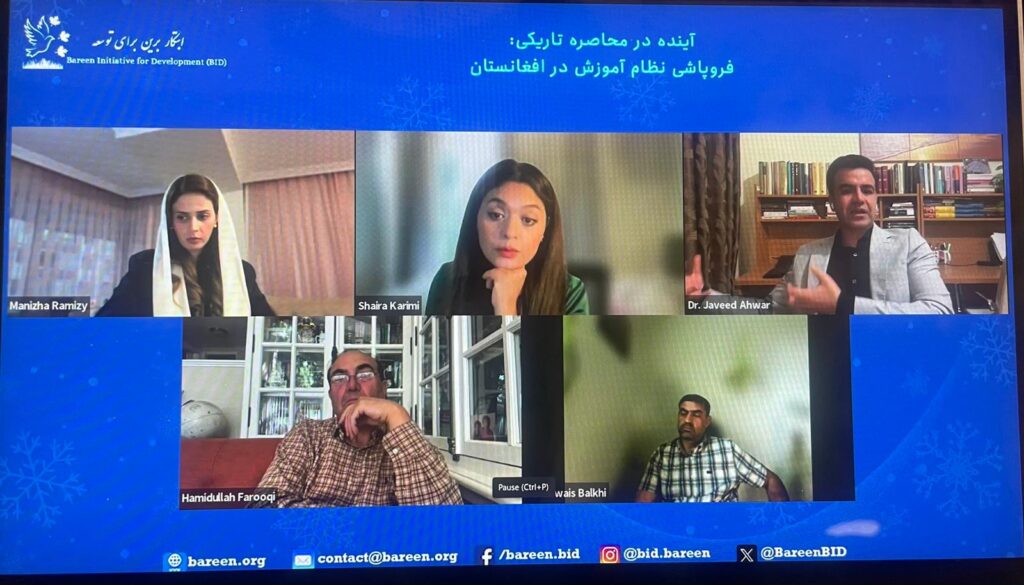
On Monday, August 11, 2025, a significant webinar titled “A Future Encircled by Darkness: The Collapse of Afghanistan’s Education System” was hosted by the Bareen Initiative for Development (BID). The event aimed to examine Afghanistan’s situation four years after the Taliban’s return to power. The webinar focused on the education crisis, restrictions on women’s rights, and the political, social, and economic impacts of Taliban policies on Afghan society.
Program Details
As part of the international webinar “A Future Besieged by Darkness: The Collapse of Afghanistan’s Education System,” organized by the Bareen Initiative for Development (BID), the event provided a platform for in-depth, multifaceted discussions on the disintegration of Afghanistan’s education system and the consequences of excluding half of the population from education. Conducted with structure, dynamism, and transnational participation, the webinar created a space to amplify the voices of the silenced and share the lived experiences of Afghans. Live-streamed across multiple platforms, the event facilitated connections among Afghan citizens, human rights activists, and the global community. The synergy of perspectives and experiences transcended geographical boundaries, serving as a conduit for amplifying the demands for justice, human dignity, and peace. The program centered on critical questions regarding the potential for internal reform within the Taliban, practical strategies to counter their policies, and the role of the global community and Afghan diaspora in supporting the Afghan people.
Panel Discussion: A Critical Analysis of Afghanistan’s Situation
The panel comprised political activists, academics, and human rights advocates who shared their expertise on analyzing Taliban policies, their social and economic ramifications, and strategies to address them.
Key Discussion Themes:
- Failure of political leaders to devise preventive strategies.
- Lack of practical plans to counter Taliban restrictions on women and youth.
- Weak political culture and absence of national consensus.
- Neglect of social transformations in Taliban-controlled areas prior to the fall of Kabul.
Speakers
The panel featured distinguished speakers, including Mr. Balkhi, Mr. Farooqi, Dr. Ahwar, and Ms. Ramizy, each offering unique perspectives on the issue:
- Dr. Mirwais Balkhi, former Minister of Education of the Islamic Republic of Afghanistan: Highlighted the Taliban’s ideological opposition to modern education.
- Mr. Hamidullah Farooqi, former Chancellor of Kabul University and author: Emphasized the need for simultaneous focus on education and political transformation, leveraging international capacities.
- Dr. Ahmad Javeed Ahwar, university professor: Critiqued the weaknesses of political parties, advocated for support of military fronts, and proposed pragmatic approaches.
- Ms. Manizha Ramizy, university professor: Stressed the need for international action and cohesive, practical programs for change.
Analysis of Speakers’ Content: Perspectives and Approaches
This section provides an analytical summary of the speakers’ contributions:
Mr. Balkhi’s Perspective:
- Described the Taliban as an ideologically driven force with extremist tendencies, viewing the suppression of modern education as central to their survival.
- Advocated for alternative education networks and small-scale local initiatives to sustain girls’ education.
- Highlighted the Taliban’s strategic propaganda and the need for effective counter-narratives.
Mr. Farooqi’s Perspective:
- Emphasized the dual focus on enhancing education and transforming the political landscape.
- Underlined the importance of international organizations like UNESCO and Afghanistan’s representation in global institutions.
- Called for cohesion among active forces and the utilization of diaspora potential for change.
Dr. Ahwar’s Perspective:
- Critiqued the inefficacy of political parties and their inability to replace the Taliban.
- Advocated for short-term support for military fronts alongside long-term programs for social and cultural integration in underdeveloped regions.
- Warned of the Taliban’s reliance on foreign aid and urged pressure on their external supporters.
Ms. Ramezy’s Perspective:
- Rejected the possibility of internal Taliban reform, emphasizing the need for externally designed initiatives.
- Highlighted the systematic exclusion of women from academic and social spheres.
- Stressed the importance of practical programs and international commitments to hold the Taliban accountable.
Proposed Strategies and Conclusion: Practical Pathways for Change
- Establishing Alternative Education Networks: Develop modern, online, and small-scale local education initiatives for girls.
- Creating Media Counter-Narratives: Utilize social media to counter the Taliban’s ideological propaganda.
- Cohesion of Opposition Forces: Form coalitions among domestic and international activists with shared objectives.
- Leveraging International Pressure: Apply pressure on countries and institutions supporting the Taliban.
- Targeted Regional Development Programs: Implement tailored approaches for urban and rural areas to bridge cultural and social divides.
Conclusion: The Need for Multidimensional and Coordinated Action
The discussions underscored the complex, multifaceted nature of Afghanistan’s crisis. Addressing Taliban policies requires a combination of short- and long-term measures, including alternative education systems, international pressure, unified opposition efforts, and targeted cultural and social programs. If implemented in a fragmented or uncoordinated manner, these efforts will have limited impact. However, with a comprehensive roadmap and active engagement from both domestic and international actors, there is hope for reversing the curtailment of rights and freedoms in Afghanistan, paving the way for a more open and just society.
Concept Note English
Concept Note Persian
English Report
Persian Report