
Introduction
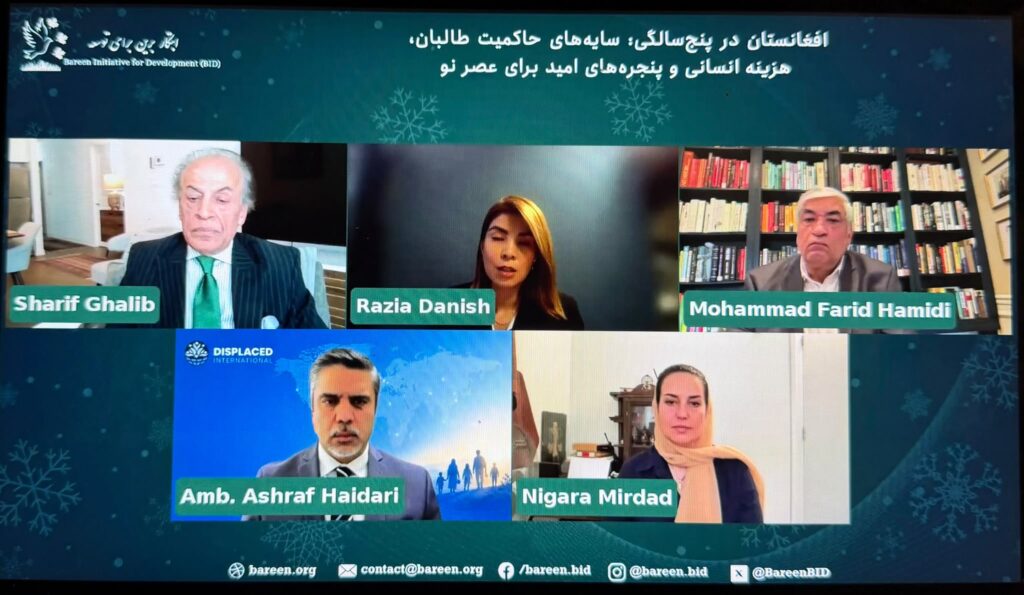
On Monday, 17 August 2026, the Bareen Initiative for Development (BID) held a webinar titled “Afghanistan at Five: Shadows of Taliban Rule, the Human Cost, and Windows of Hope for a New Era”. Marking the fifth anniversary of the Taliban’s return to power, Afghanistan continues to grapple with multiple overlapping crises—human rights, political, economic, and social. Five years of Taliban governance have been defined by severe restrictions, widespread deprivation, mass migration, and the exclusion of more than 2.5 million girls from education. Alongside internal challenges such as field-level insecurity, factional tensions within Taliban ranks, and the detention of protesters, border clashes and diplomatic frictions with neighboring countries have added new layers of complexity. The webinar was convened to assess the past five years, critically examine the shortcomings of the Republic era, and explore practical pathways and alternative frameworks for Afghanistan’s future.
Program Details
- Main objectives: Evaluate the current governance situation, critique the policies of the international community, diagnose the failures of the Republic system, and examine approaches for building political consensus and alternative structures for the future.
- Moderator: Razia Danish, journalist at Iran International.
Speakers:
- Mohammad Farid Hamidi, former Attorney General of the Islamic Republic of Afghanistan
- Sharif Ghaleb, former policy advisor at the Afghan Ministry of Foreign Affairs
- Ambassador Ashraf Haidari, President of Displaced International and researcher at Arizona State University
- Nigara Mirdad, former Deputy Ambassador of the Islamic Republic of Afghanistan to Poland
Key Analyses by the Speakers
Mr. Mohammad Farid Hamidi’s perspective
- Absence of legitimacy and the rule of law: The Taliban lack both domestic legitimacy and international recognition. They govern solely through force, repression, intimidation, and personal decrees rooted in a mullah-centric system. No lawful institutional framework exists in the country.
- Long-term consequences and gender apartheid: The effects of the Taliban’s current policies—including gender apartheid and the overhaul of the education system—will not be confined to the present. They will shape Afghanistan’s economy, education, and future generations for decades to come.
- Critique of the international community and the erosion of values: Despite their human-rights rhetoric and commitments, Western countries and the broader international community engage with the Taliban for short-term security and self-interest.
- Role of extremist religious Madrases: The establishment of hundreds of hardline religious seminaries by Taliban authorities not only attracts financial resources but is also training a new generation of fighters to entrench the authoritarian system.
Mr. Sharif Ghalib’s perspective
- The world’s pragmatic engagement centered on “security”: The international community has accepted the Taliban as a “bitter reality on the ground.” Driven by the need to manage humanitarian aid, combat narcotics, and control migration, it has relied on the Taliban’s claims of relative security.
- The necessity of internal self-criticism and diagnosing the Republic: Not all blame can be placed on the international community. The Republic system lacked a clear vision, was steeped in corruption and ethnic favoritism, and collapsed overnight under self-absorbed and delusional leadership.
- A realistic and forward-looking perspective: Change in Afghanistan is inevitable. Elites must learn from the past, address shortcomings, and present a national, workable plan for the future.
Mr. Ashraf Haidari’s perspective
- The Taliban as a foreign geopolitical project: The Taliban constitute a security project and proxy force created and imposed by Pakistani intelligence.
- Rejection of the security claim and the reality of silent deaths: Security has both human and protective dimensions; the Afghan people enjoy neither. Due to the cutoff of aid and economic collapse, hundreds of children and mothers die every day—casualties of the regime’s “indirect violence.”
- Threat from more than 20 terrorist groups: The presence of over 20 terrorist groups operating under the Taliban’s umbrella endangers regional and international security.
- Proposal for a “Regional Compact”: Resolving the Afghan crisis requires a regional and trans-regional agreement aimed at ending external interference, eliminating terrorism, ensuring equitable management of transboundary waters, and expanding trade.
Ms. Nigara Mirdad’s perspective
- Crisis of “political order” and the rejection of stability without rights: Afghanistan’s core problem is not merely a humanitarian crisis but the collapse of political order and the redefinition of the relationship between state and citizen. Stability without women’s participation and citizenship rights is not stability—it is the creation of crisis.
- The danger of normalizing repression and the exclusion of women: Removing women from public life and the brain drain will disable Afghanistan’s economic and administrative capacity for decades. Normalizing repression makes the crisis permanent.
- External challenges in the absence of a political alternative: Over the past five years, no regional or Western country has provided a centralized political platform for opposition forces, civil society, and women to convene. Focus has remained solely on managing the humanitarian crisis.
- Presenting a national plan grounded in political rationality: Opposition groups and civic movements must review past weaknesses, engage in self-criticism, and put forward a comprehensive plan for a future in which Afghanistan lives in peace with itself, the region, and the world.
Overall Assessment of the Webinar
- The hollowness of the Taliban’s security claims: The security the Taliban claim is fragile and rests on the denial of rights, the closure of schools, the suppression of freedoms, and silent human losses.
- The contradiction and double standards of the international community: Western and regional states have subordinated human-rights principles to security, economic, and migration interests, using technical engagement to normalize the regime.
- The need for honest self-criticism of the 20-year Republic: Any future political plan or alternative will fail without a candid examination of the corruption, exclusivity, and structural weaknesses of the Republic era.
Conclusion
The speakers’ final assessments can be summarized in three strategic pillars:
- Strengthening civic awareness and the role of the diaspora
- The Afghan diaspora should leverage its capacity, knowledge, and citizenship rights in Western countries to exert political pressure, influence policy, and pursue advocacy.
- Condition financial remittances sent by the diaspora to families inside Afghanistan on support for girls’ home-based and informal education.
- Drafting a comprehensive national plan and political alternative
- Opposition forces, women, civil society, and experts must, through political rationality, past diagnosis, and the setting aside of differences, reach consensus on a coherent vision for a future system that guarantees the rights of all citizens.
- Establishing a “Regional Compact” and global engagement
- The Afghan crisis (terrorism, climate change, migration, narcotics, and water) has transnational dimensions. Regional and international actors must move beyond short-term deal-making and pursue structured cooperation—centered on the region with broader support—to achieve lasting stability and the elimination of terrorism in Afghanistan.
Report English
Report Persian
Concept Note English
Concept Note Persian