
Introduction
On Sunday, June 7, 2026, the Bareen Initiative for Development (BID) hosted a webinar titled “UN Report Exposes Taliban’s Systematic Erasure of Women: The New Divorce Decree and Deepening Gender Apartheid.” Speakers provided in-depth legal, analytical, and strategic examinations of the Taliban’s latest decree, while amplifying Afghan women’s voices and calling for a coordinated international response. They emphasized that Afghanistan under Taliban rule is experiencing one of the most severe, deliberate, and rapid reversals of human rights in modern history. The issuance of Taliban Decree No. 18, titled “Principles on the Separation of Spouses,” dated May 14, 2026, has been described by UN Women, UNAMA, and other international bodies not as a mere religious ruling, but as a strategic step to consolidate and deepen gender apartheid. By targeting the very structure of the family, the decree creates the legal foundation to legitimize child marriage and strip women of judicial independence.
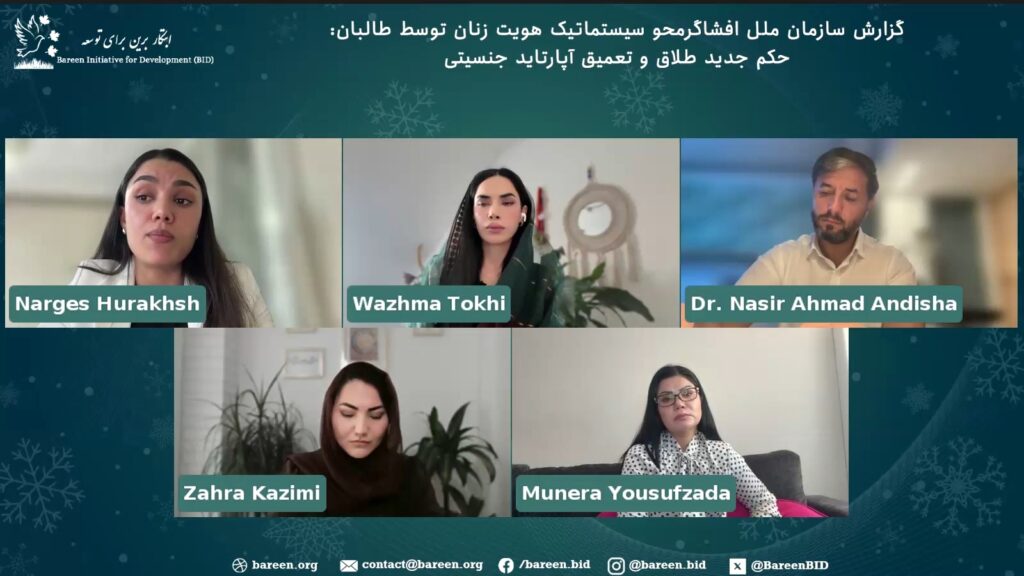
Program Detail
The specialized webinar, organized by the Bareen Initiative for Development (BID), examined the profound dimensions of the crisis in Taliban-ruled Afghanistan.
- Main Objective: To conduct analytical, legal, and strategic reviews of the new Taliban decree, strengthen the voice of Afghan women, and urge a unified international response.
Speakers:
- Dr. Nasir Ahmad Andisha: Ambassador and Permanent Representative of Afghanistan to Geneva.
- Zahra Kazemi: Political analyst and Chair of the NRF Women’s Council.
- Monera Yousufzada: Former Deputy Minister of Defence of the Islamic Republic of Afghanistan.
- Wazhma Tokhi: Founder of the Pohana Foundation and activist for education and human rights.
Key Analyses by the Speakers
Dr. Nasir Ahmad Andisha’s Perspective
Legal and Structural Analysis of Rights Deprivation and Reverse Social Engineering
- This decree continues the Taliban’s efforts to completely dismantle the previous rights-based and citizen-centered judicial system. Taliban legislation is fundamentally not rights-oriented; citizens are not viewed as rights-holders but merely as subjects bound by imposed duties and obligations.
- Lack of Contemporary Religious Legitimacy: These laws are based on fatwas from five or six centuries ago, drafted by individuals with the lowest level of jurisprudential knowledge. This regressive approach stands in complete contradiction to contemporary Hanafi jurisprudence practiced in countries such as Pakistan, Turkey, Egypt, and Syria.
- Top-Down Legislative Crisis: Law-making has shifted from a popular, expert-driven, and parliamentary process to an arbitrary and despotic exercise of individual discretion.
Risks of Implications of Decree No. 18 for Children’s Rights:
- Using Puberty Instead of Legal Age: The Taliban have replaced the legal age of marriage (previously 16 for girls) with the vague criterion of “puberty.” Given widespread poverty, lack of education, and environmental stress, girls now reach puberty as early as 9 to 11 years old. This effectively legalizes child marriage.
- Interpreting Silence as Consent: If a girl is married off as a child, her silence or lack of explicit objection after reaching puberty is taken as consent. Under international law and conventions such as CEDAW and the Convention on the Rights of the Child, consent must be free, explicit, and informed. Silence under social pressure and fear can never constitute genuine consent.
- Severe Restrictions on Women’s Right to Divorce: While men are granted unilateral divorce rights, women face heavy evidentiary burdens and complex procedures within the Taliban’s judicial system, making escape from domestic violence virtually impossible.
Zahra Kazimi’s Perspective
Political, Social, and Ethnic Consequences
- Lord-and-Serf System and Objectification of Women: The Taliban view the nation as their subjects and have reduced women — half of society — to controllable objects.
- Expansion of Discrimination into Ethnic and Religious Spheres: After consolidating restrictions on women, the Taliban’s exclusionary policies have now adopted a takfiri approach targeting the language, culture, and religion of other citizens, particularly the Shia community.
Munera Yousufzada’s Perspective
Social Control and Defamation
- Total Control Over the Family Institution: Having seized state structures, the Taliban now seek absolute control over families by dictating what is permitted and forbidden, aiming to create a silent and obedient society.
- Project to Defame Afghan Men: These decrees shape global public opinion to portray Afghan men as inherently violent and opposed to modern laws, despite the fact that Afghan society and its men showed openness to positive change and support for women’s rights over the past twenty years.
Wazhma Tokhi’s Perspective
Independent Rights Advocacy and Critique of the International Community
- Inherent Rights, Not Charity: Education, work, freedom, and political participation are not privileges to be granted to women but natural, inalienable rights that should not be demanded as favors.
- Criticism of International Positions: International statements on Afghan women have become clichéd and repetitive. Global powers make decisions based on their own interests, and no external actor will deliver a solution purely in the Afghan people’s favour. The primary victims are the Afghan people themselves.
Overall Assessment of the Webinar
- Need for Structural Transformation: Gender apartheid cannot be dismantled through superficial or cosmetic reforms. Systematic discrimination will persist until the exclusive power structure itself is changed.
- Rejection of Cultural Justification: Both domestic speakers and international institutions strongly condemned attempts by some Western-based lobbyists to downplay these decrees under the guise of “Afghan cultural traditions,” describing such efforts as dangerous.
- Continued Physical Repression: During the webinar, disturbing reports emerged from Herat province of the mass arrest, beating, and severe violence against 20 to 60 women for refusing Taliban-mandated dress codes — clear evidence of the regime’s ongoing machinery of physical suppression.
Conclusion
The analyses presented in this webinar clearly demonstrate that the situation in Afghanistan is far more than a temporary human rights crisis or a reformable systemic deviation. It represents a comprehensive and re-engineered gender apartheid that targets the entire social fabric and civilizational thinking of a nation.
The final assessment can be summarized in three strategic axes:
- Extending Gender Apartheid from Public Space into the Private Sphere of the Family
Taliban Decree No. 18 (“Principles on the Separation of Spouses”) serves as a new legal tool to institutionalize repression within the most fundamental unit of society — the family. By substituting physical puberty for legal marriage age and interpreting girls’ silence as explicit consent, the Taliban’s judiciary has become an instrument that legitimizes domestic violence and child marriage. The webinar firmly rejected any international lobbying efforts to reduce this legal catastrophe to “indigenous traditions,” viewing such attempts as making the global community complicit in this apartheid. Only structural transformation of power can contain this crisis.
- Linking the Machinery of Physical Repression with Generational Reverse Engineering
Field realities — including the simultaneous mass arrests and beatings of dozens of women in Herat for defying mandatory dress codes — show that the regime’s exclusionary theories are immediately translated into action. The Taliban are pursuing a dangerous two-phase program: first, physically eliminating female teachers, doctors, journalists, and diplomats to erase Afghan women’s identity from collective memory; second, using hundreds of radical madrassas to reverse-engineer the mindset of future generations. Without intervention, Afghanistan risks becoming, within a decade, not only a site of internal crisis but a primary incubator and exporter of extremism across the region.
- Deadlock of Clichéd Diplomacy and the Need for an Offensive Strategy
Repetitive, ineffective UN statements, alongside overt deal-making by regional and global powers (such as India-Pakistan economic ties or Germany’s recent refugee expulsion agreements), reveal that national interests consistently outweigh fundamental human rights. While preserving Afghanistan’s official seat at the UN and legal reporting mechanisms (“goal-keeping”) have been vital over the past five years, they are no longer sufficient. The genuine alternative is to shift the center of gravity of the struggle from the diaspora to inside the country by building local networks of influence. With the collapse of the economy and deepening social impasses, the wall of Taliban intimidation is cracking. Afghan society has reached a point of collective exhaustion. Strengthening internal dynamics and layers of domestic resistance is now the key to meaningful structural change.
Concept Note English
Concept Note Persian
Report English
Report Persian