
Introduction
On Saturday, May 2, 2026, a timely webinar titled “Diplomacy, Geopolitics and Development – Strategic Choices in a Volatile Region” was hosted by the Bareen Initiative for Development (BID). The event tried to decode the role of Pakistan as a mediator in the ongoing US and Israel war on Iran and the impact it has on its neighbour Afghanistan, with whom it seeks to end its own war.
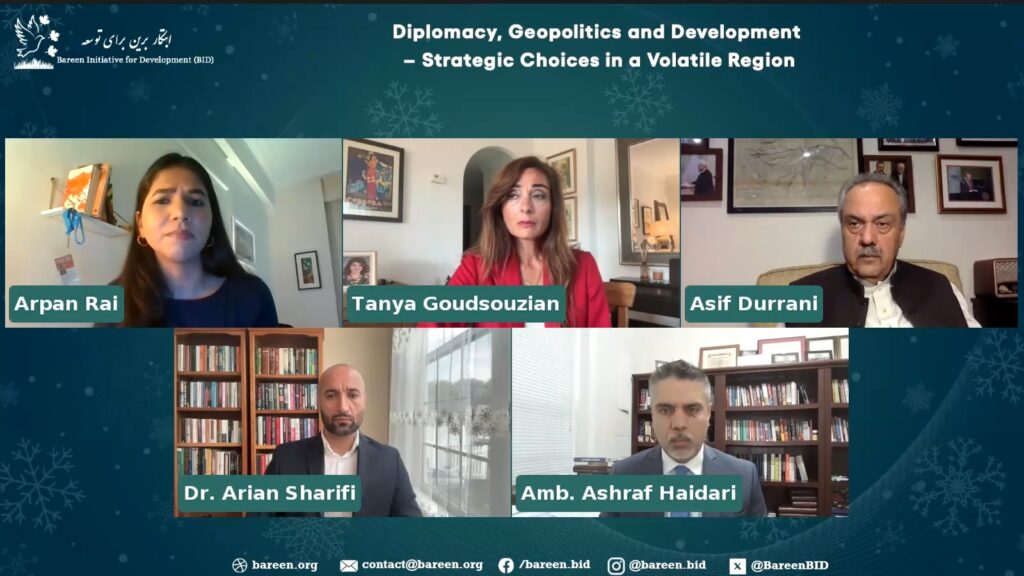
The webinar’s four segments looked at how countries – particularly in developing and strategically sensitive regions – must navigate increasing geopolitical uncertainty while pursuing economic development and political stability. Keeping Pakistan and Afghanistan at the center stage, the discussion explored the intersection of diplomacy, security and economic interests, and regional cooperation in a world shaped by power-brokering capabilities and regions recovering from decades of war.
Program Details
As part of the international webinar “Diplomacy, Geopolitics and Development – Strategic Choices in a Volatile Region” organized by the Bareen Initiative for Development (BID), the event provided a platform for evidence and facts-based discussions on Pakistan’s shuttle diplomacy as it hosts rare direct US-Iran talks in Islamabad, dispatching high-level delegations led by the Army Chief to Tehran, and pushing for renewed ceasefires amid a fragile truce. The move positioned Islamabad as a credible intermediary but also changed what it can do to influence the calls for a regime change in Afghanistan.
With diverse experience-enriched perspectives from the speakers from both the countries, the webinar platformed the advantages Pakistan can bring as a stakeholder in the region but also the risk such a cooperation can bring for Afghanistan, which is seeking an end to Islamabad’s declared open-war.
The conversation was live-streamed across multiple platforms and the event facilitated dialogue among Afghan citizens, its diaspora abroad, human rights activists, speakers from Pakistan, Afghanistan and the global community. The synergy of perspectives and experiences transcended geographical boundaries, serving as a conduit for amplifying the demands for justice, human dignity, and peace.
Panel Discussion: A Critical Analysis of Pakistan and Afghanistan ties
The panel was composed of former diplomats, regional experts and researchers who have monitored the conflict that has killed dozens and displaced thousands between the two Asian powers followed by a high-stakes diplomacy by Islamabad.
It particularly benefitted from the experience and understanding of the regional landscape offered by Ambassador Asif Durrani, who highlighted that while Pakistan faces threats of growing terrorism groups under the Taliban regime, Afghanistan’s future should be left to the country’s population.
Key Discussion Themes:
- Pakistan’s mediator role in the ongoing 2026 US-Iran war
- The mechanics and impact of shuttle diplomacy combined with Pakistan’s efforts to extend ceasefires and reopen critical routes
- How Islamabad is walking the tightrope of balancing ties with its Middle Eastern allies and the new-found ally in the West – the US
- Pakistan’s conflict with the Taliban-led regime over TTP sanctuaries
- Possible ways to mitigate the tensions and end the deadlock between the Pakistan and Afghanistan
Speakers
The panel featured distinguished speakers, including Mr Durrani, Ms Tanya Goudsouzian, Mr Md Ashraf Haidari and Dr Arian Sharifi, each offering unique perspectives on the issue:
- Ambassador Asif Durrani, Pakistan’s former special representative on Afghanistan and Iran: Offered insights on Pakistan’s need to fulfill the responsibility of being a mutual partner of interest to the US and Iran as it sits on the intersection of both conflicts – the one in the Middle East and the one it has with Afghanistan.
- Md Ashraf Haidari, former Afghanistan ambassador to India, the US and Sri Lanka and distinguished fellow at Arizona State University School of Politics and Global Studies: Explained how Pakistan is in the best position to call for a change in the region, especially Afghanistan by leading a UN-backed process for sustainable change.
- Tanya Goudsouzian, scholar and senior journalist: Underlined changing global politics, how Pakistan played an “improbable” role and how the country has real stakes in the outcome of the war between the US and Iran.
- Dr. Arian Sharifi, former lecturer and chair of the Master in Public Policy Program at Princeton University’s School of Public and International Affairs and international affairs expert: Highlighted opportunities and challenges for both – Pakistan and Afghanistan from the crisis, especially on how a change can be brought for an equitable power distribution in the Afghan society.
Proposed Strategies and Conclusion
- The immediate objective is deescalation, extending ceasefires and preventing further escalation. But beyond that there is a broader ambition to create space for structured negotiations on nuclear issues, the opening of the state of harness, sanctions relief and regional stability. If successful, this diplomacy could reopen critical energy and trade corridors which are vital not just for Pakistan but for the wider region.
- Peace-led diplomatic allyship: Pakistan’s challenge now is to sustain the mediator role without overreach and ensuring that its credibility is reinforced rather than undermined. It may be a sign of what diplomacy will increasingly look like in a more multi-polar world where the most effective mediators are not always the most obvious ones.
- Need of the hour: It is critical that Pakistan takes active steps to resolve its issues with Afghanistan and have a mutually respected and respectful relationship with its neighbour.
Conclusion: Rising regional responsibility while solving the world’s biggest conflict is not a choice but an imperative
The nearly two-hour long conversation concluded that Pakistan has stepped in at an extraordinary timing with an even more extraordinary role to fulfill while the world grapples with a prolonged period of uncertainty characterised by fragmentation, strategic competition, and rapid geopolitical shifts.
In such an environment, countries like Pakistan must move beyond reactive policymaking and adopt integrated strategies that combine diplomacy, economic resilience, security preparedness, and regional cooperation.
However, as Ambassador Durrani pointed out and agreed by the panel of experts – Pakistan had no choice but to react in the wake of the sharpest increase in oil prices and the whole of Asia suffering as a result of the blockade of the Strait of Hormuz. The conflict is not in any regional player’s favour.
The experts also agreed on disunity among all the political opposition leaders of the Taliban regime, harming the country’s political stability for decades.
“If that comes, no power on Earth can interfere in Afghanistan’s affairs. For instance, you have seen the war in war with Iran. Americans tried to go for regime change. They have failed,” Ambassador Durrani said.
Pakistan has unlocked a newfound gravitas but it will also have to assess the regional spillover of its conflict-management, including the growing resentment from the Baluchistan separatist groups and terrorist groups like Baluchistan Liberation Army (BLA).
However – in both the conflicts, experts pointed out Pakistan cannot end the wars as its leaders “can only take the horse to uh water but it can’t make it drink whether it is Iran or the US”.
Concept Note English
Concept Note Persain
English Report