
Introduction
On Saturday, March 14, 2026, the Bareen Initiative for Development (BID) hosted a webinar titled “From Matilda to Kabul: The Denial of Women – A Current Policy Defying Human Standards.” The event took place against the backdrop of a stark global contradiction in how women’s rights are treated. While many countries celebrate women’s achievements, in Afghanistan under Taliban rule, women are deprived of even the most basic human rights and the ability to live ordinary lives. The webinar’s central focus was to explain the concept of the Matilda effect—originally a bias in which women’s scientific contributions are overlooked or credited to men—and how it has evolved under the Taliban from a scientific prejudice into a deliberate, strategic state policy of structural and systematic elimination of women from public life. Experts warned that what is happening in Afghanistan today goes far beyond traditional discrimination: it constitutes full-scale gender apartheid and crimes against humanity.
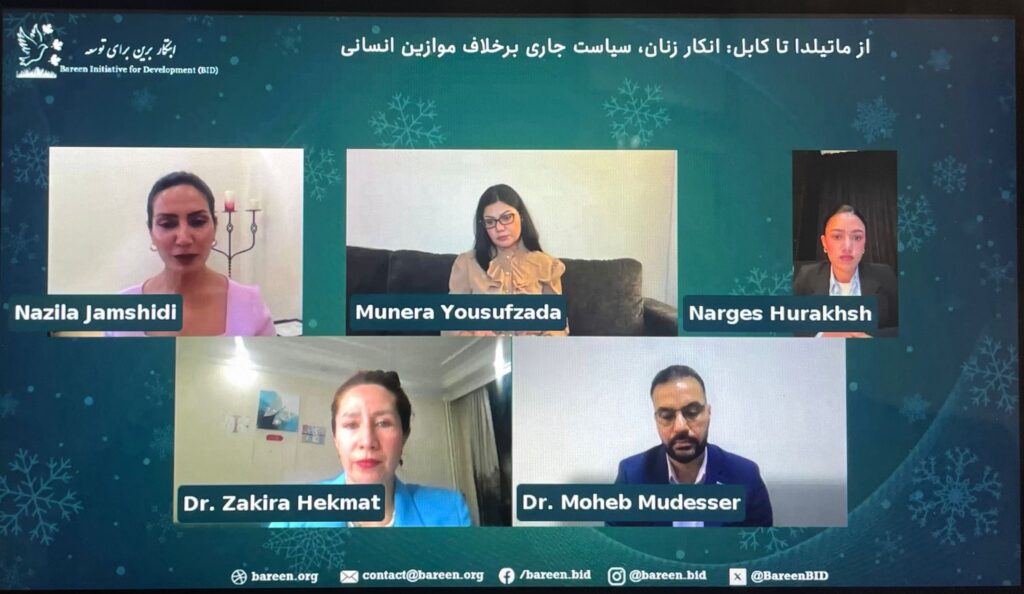
Program Overview
This specialized webinar, organized by the Bareen Initiative for Development (BID), examined the profound dimensions of women’s situation in Afghanistan under Taliban rule.
- Main Objective: To analyze the historical roots of women’s exclusion, trace the transition from invisibility to structural erasure, and clarify the legal dimensions of gender apartheid in Afghanistan. The event was held in connection with March 8, International Women’s Day, to strengthen solidarity with Afghan women’s civil resistance.
- Core Theme: The connection between historical patterns of gender inequality (the Matilda effect) and today’s political and security realities, including the criminalization of women’s social presence.
Speakers and Moderator
- Ms. Nazila Jamshidi, Policy, Gender Equality & Human Rights Specialist
- Munera Yousufzada, Former Deputy Minister of Defence of Islamic Republic of Afghanistan
- Dr Moheb Mudesser, International Human Rights Researcher
- Dr. Zakira Hekmat, Afghanistan women’s rights watch
- Narges Hurakhsh, Correspondent at Afghanistan International and Iran International
Key Insights from the Speakers:
Ms. Jamshidi explained the historical Matilda effect—where women’s scientific achievements are ignored or attributed to men—and extended it to contemporary contexts:
- Male-dominated historiography: Even in major movements like the Arab Spring or Afghanistan’s democratic struggles, women’s roles and sacrifices are marginalized in historical narratives and research.
- Erasure as strategy: The removal of women from public space is now a deliberate governmental policy, not merely a side effect.
- Institutionalization of inequality: While the Matilda effect varies in intensity across societies, under the Taliban it has taken a radical, systematic form.
Munera Yousufzada
- Three-stage progression: She analysed women’s situation in three phases—being ignored, being restricted, and finally being structurally eliminated.
- Erasure of citizenship: The Taliban are transforming women from active citizens into completely dependent beings, resulting in the effective cancellation of their citizenship.
- Primitive interpretation of power: By masculinizing interpretations of religion and authority, the Taliban seek total control over women’s bodies, voices, and very existence as a means of asserting dominance.
- Anti-society agenda: She stressed that the Taliban’s actions are not merely misogyny but broad anti-society measures that threaten the future of humanity.
Dr Moheb Mudesser,
Dr Mudesser, highlighted the fundamental differences between ordinary discrimination and the current situation in Afghanistan from an international law perspective:
- Criminalization of presence: Unlike in Western societies, women’s mere presence in public has been criminalized in Afghanistan.
- Definition of gender apartheid: He described gender apartheid as a system in which a political regime institutionally excludes one gender from public life and perpetuates the domination of one sex over the other.
- Crimes against humanity: Citing people’s tribunals and the Rome Statute, he classified the Taliban’s actions—including the issuance of over 150 restrictive decrees—as clear examples of gender-based persecution and crimes against humanity.
Dr. Zakira Hekmat
As a human rights activist and recipient of the International Women of Courage Award, Dr. Hekmat addressed cross-border challenges and the situation of refugees:
- Women as primary victims of displacement: Taliban exclusionary policies have triggered a massive wave of migration among female elites. This is not just geographical movement—it is an effort to preserve the right to life and right to identity denied within Afghanistan’s borders.
- Systemic isolation in exile: The Matilda effect pursues Afghan women even abroad, where their voices are sidelined in political and diplomatic equations or sacrificed in closed-door deals with the Taliban.
- Responsibility of neighboring countries: She insisted that regional countries and the international community must not legitimize gender apartheid by normalizing relations with the Taliban regime. She called for structured support for exiled women activists to maintain the link between internal resistance and external diplomacy.
- Shifting the narrative from victimhood: Despite Taliban pressure for total erasure, Afghan women have seized even the smallest opportunities—in cyberspace and host communities—to challenge the Taliban’s narrative.
Proposed Solutions
- Recognition of gender apartheid in international law to hold the Taliban accountable.
- Strengthening global solidarity: The international community must move beyond superficial statements and impose real pressure.
- Continued documentation of gender-based abuses for submission to international criminal courts.
- Support for internal resistance: Creating alternative channels to amplify women’s voices inside Afghanistan and backing informal educational and economic structures.
Conclusion
The discussions revealed that what is unfolding in Afghanistan is not simply a traditional regression but a structural and systematic denial rooted in historical patterns of overlooking women (the Matilda effect), now manifesting as brutal gender apartheid. Key points include:
- Transition from invisibility to physical elimination: The Taliban have moved beyond denying women’s achievements to criminalizing their very presence, redefining women not as citizens but as entities without independent identity.
- Link between global security and women’s rights: Erasing women and turning education into a tool for ideological indoctrination is not merely an internal crisis; a society that paralyzes half its body and radicalizes the other half will soon become a source of regional and global instability.
- Irreparable loss of human capital: The exodus of elites and denial of education to girls has created a specialized and cultural void that will take decades—not years—to repair, effectively destroying Afghanistan’s development foundations.
- Failure of international silence: The world must not allow Afghanistan to become a forgotten issue. Normalizing relations with a regime built on gender apartheid means abandoning all human and international legal standards.
- Weaponization of religion for repression: The Taliban use fabricated narratives of past “moral corruption” to convince traditional society to accept tighter control over women.
This webinar served as a powerful call to recognize the severity of the crisis and to act decisively in solidarity with Afghan women.
Concept Note English
Concept Note Persian
English Report
Persian Report