
Introduction:
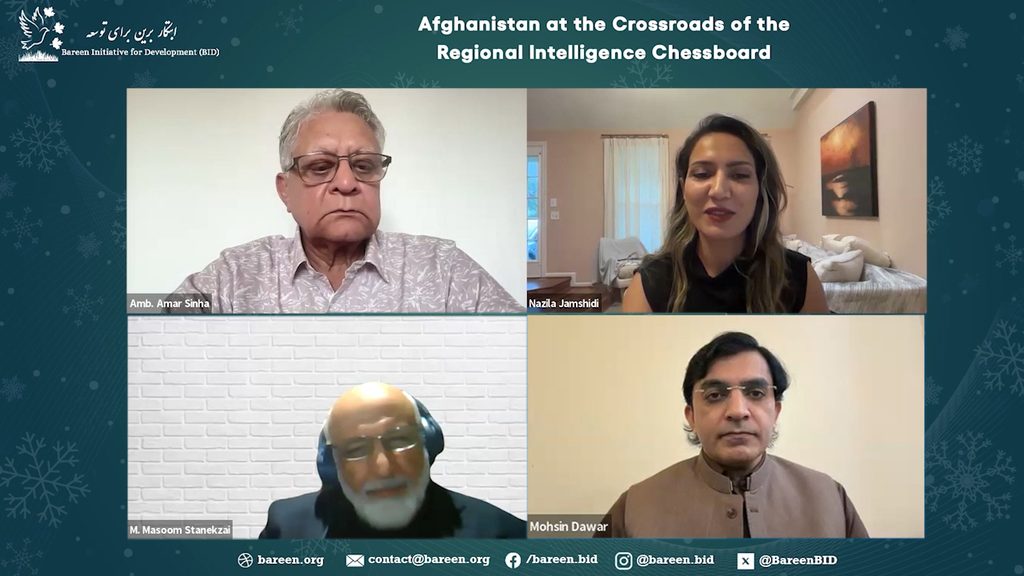
On Sunday 4 October 2026, Bareen Initiative for Development (BID) held a webinar titled “Afghanistan at the Crossroads of the Regional Intelligence Chessboard” to analyze the evolving dynamics of regional security, intelligence diplomacy, and international engagement with Kabul. The session addressed high-level diplomatic and intelligence visits to Kabul and Kandahar specifically senior delegations from Türkiye (led by Intelligence Chief İbrahim Kalın) and Qatar focusing on counter narcotics, border tensions between Kabul and Islamabad, and regional security cooperation. The event critically examined whether Afghanistan is increasingly managed solely as a security problem or as a broader political entity requiring inclusive governance, human rights guarantees, and civic representation.
Program Details:
- Main Objectives: Evaluate intelligence led diplomacy, examine the security dynamics between Afghanistan and neighboring states (notably Pakistan), assess the sustainability of security oriented regional engagement, and explore pathways toward legitimate political governance and inclusion.
Moderator:
- Nazila Jamshidi, Policy, Gender Equality and Human Rights Specialist.
Distinguished Speakers:
- Mohammad Masoom Stanekzai: Former Chief of the National Directorate of Security (NDS) of I.R Afghanistan.
- Mohsin Dawar: President of the National Democratic Movement of Pakistan.
- Ambassador Amar Sinha: Former Ambassador of India for Afghanistan.
Key Analyses by the Speakers:
Perspective of Mr. M. Masoom Stanekzai
- Shift to Intelligence Channels and Geopolitical Dynamics: Intelligence channels have replaced traditional diplomatic avenues due to the US strategic pivot, competing regional priorities, middle power security arrangements, and the Taliban’s internal legitimacy deficit. Delegations travel directly to Kandahar because ultimate decision-making power resides with the Taliban’s supreme leadership rather than Kabul ministries.
- Short Term Security Focus vs. Long Term Governance Crisis: Regional states engage through a narrow counter terrorism and short-term security lens. However, governance without a constitutional framework, civil rights, modern education, or institutional legitimacy cannot deliver sustainable long-term stability.
- Regional Disunity and Fragmentation: Regional actors lack a unified policy, pursuing fragmented, short term interests. The weakening of UN multilateralism has led to mini lateral formats that fail to resolve underlying political causes.
- Risk of Extremism and Ungoverned Spaces: Relying on militancy or ignoring educational collapse risks creating ungoverned spaces and long-term security backlashes across the region.
Perspective of Mr. Mohsin Dawar
- Lack of Legitimate Political Representation: Engagement with the Taliban fails to represent the will of the Afghan people, who are excluded from shaping their country’s future. Afghanistan functions as a closed space where women and citizens are systematically stripped of basic rights.
- Critique of State Policies and Exploitation of Insecurity: The current situation allows external actors to exploit the lack of a legitimate Afghan government. Military actions and border strikes frequently harm innocent civilians and infrastructure rather than addressing root causes.
- Militancy and Regional Proxy Dynamics: Militant groups continue to be used as strategic tools to suppress domestic political dissent, counter regional nationalism, and advance broader geopolitical agendas at the expense of local populations.
- Necessity of Authentic Afghan Political Agency: Sustainable peace requires building genuine political structures and platforms that amplify the authentic political voice and will of the Afghan people.
Perspective of Ambassador Amar Sinha
- Motivations and Limits of Intelligence Diplomacy: While intelligence diplomacy addresses immediate tactical concerns, counter terrorism, and threat assessments, it operates on fundamental distrust and cannot serve as a substitute for action oriented, long-term state diplomacy.
- Need for Rapprochement and Internal Legitimacy: Sustainable stability requires internal reconciliation within Afghanistan. A regime that excludes half of its population from social, educational, and economic life cannot achieve international recognition or long-term state normalization.
- Regional Dynamics and Strategic Misperceptions: Regional powers must avoid viewing bilateral relationships as zero sum games. Misperceptions regarding regional influence often distort security policies and hinder constructive cooperation.
- Risks of Treating Afghanistan Solely as a Security Problem: Reducing engagement strictly to risk containment threatens to marginalize Afghanistan internationally, creating severe long-term security risks for neighboring countries.
Overall Assessment of the Event:
- Inadequacy of Security Led Diplomacy: Tactical security engagement and intelligence channels manage immediate crises but cannot solve Afghanistan’s fundamental political, economic, and humanitarian crises.
- The Primacy of Domestic Legitimacy: Regional and international efforts will remain fragile without a clear constitutional framework, inclusive governance, and the restoration of fundamental rights for all citizens, including women and minorities.
- Dangers of Normalization Without Conditions: Treating security arrangements as a substitute for political process risks normalizing repression and entrenching long-term regional instability.
Conclusion:
- Limits of Security Diplomacy: Intelligence channels and security arrangements can only manage immediate crises temporarily; they cannot resolve the root causes of Afghanistan’s political, economic, and humanitarian crises.
- Primacy of Domestic Legitimacy: Sustainable stability is impossible without a constitutional framework, inclusive governance, and the restoration of fundamental rights for all citizens, especially women’s rights to education and work.
- Risk of Normalizing Repression: Replacing genuine political processes with security agreements risks normalizing the current status quo and deepening long-term regional instability.
- Multi-Dimensional Regional Engagement: Regional powers must move beyond a narrow security centric approach and integrate human rights, political inclusion, and the rule of law into their diplomatic frameworks.
- Authentic Afghan Agency: Achieving peace requires creating platforms for inclusive dialogue among Afghan civic, political, and women leaders to shape a unified national vision.
- Multilateral Cooperation: Regional states must agree on minimum political conditions and leverage structured UN mechanisms to prevent ungoverned spaces.
Concept Note English
Concept Note Persian
Report English
Report Persian