
Disclaimer: this article reflects the author’s personal view and is not affiliated with any organization or institution.
“Recent reports and experts warn that Kabul could exhaust its water supply by 2030, risking mass displacement and chaos unless residents and officials act now”.
KABUL—a city with over five million residents—struggles with water challenges. “Our borewells have completely dried up,” says Shafiqullah Hamkar from district five of Kabul city. “We have no choice but to rely on commercial water tankers for our most basic needs.” This bleak situation is not unique. Reports and experts say that Kabul’s groundwater, the heart of the city, is being dried. The source that formerly supplied the capital has diminished by 25-30 meters over the past decade, and roughly as per the UN report, 49 percent of the underground water-wells are already dry. The extraction of water has severely reduced the amount of natural recharge (by 44 million cubic meters per year) and scientists have warned that if no drastic action is taken, the city will deplete its water source by 2030. In other words, Kabul could very soon be the first major capital city in the world to run out of water.
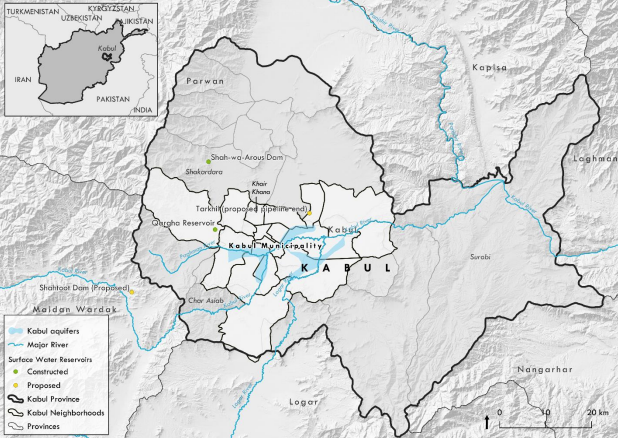
Kabul’s major water sources and key infrastructure, © Mercy Corps
The human cost is already immense. Clean water has become a precious commodity. Poor class Afghan households allocate a significant portion of their income to purchase drinking water. At the same time, water quality has seen a drastic decline: 80 percent of Kabul’s water is contaminated with sewage and salts, harmful metals like arsenic and nitrates. Cape Town faces an unprecedented water shortage which is crucial and affects all sectors of the city, including schools and hospitals. More than two-thirds of families are in debt because of water-related costs, while a significant number spend up to 30 percent of their income on water bills. On top of this, the return of 1.4 million returnees from Pakistan and Iran since the start of 2025 would additionally add to this crisis. Inaction of water will be a disaster for millions, undermining economic recovery and fueling new waves of migration or internal displacements.
These crises have been decades in making. Climate change, relentless drought, and urban growth have collided with systemic mismanagement. Between 2021 and 2024, Afghanistan suffered one of its worst droughts on record – by 2023, 67 percent of households reported devastating impacts on their livelihoods, while the Hindu Kush mountains, Kabul’s lifeline, retained just half their normal snowfall. At the same time, Kabul’s population has surged from one million in 2001 to over six million today, with overwhelming infrastructure and resources. Decades of foreign aid failed to deliver a lasting solution: SIGAR reported that out of $19 billion (30-40 percent of construction funds) vanished into wasteful projects, while little invested in long-term systems or local expertise. The collapse of USAID under Trump administration dealt another blow, crippling critical water and sanitation programs when they were needed most.
Moreover, following the collapse of the Islamic Republic of Afghanistan, most water agencies, such as the Ministry of Energy and Water (MoEW) and the new National Water Affairs Regulation Authority (NWARA), have lost most of their experts and capacity; most of the technical staff have either been fired or fled the country. Despite some good practices on the ground, the massive construction of buildings in Kabul’s districts (e.g., 1, 2, 3, 4, and 10) has led to poor overall coordination, outdated or unenforced regulations, fragmented data, and largely unregulated new well-drilling. Private companies have started drilling deep boreholes to sell limited groundwater back to households at inflated prices. As one resident observed, families used to pay 500 AFN or more for 10 days of water; now that has doubled. In short, Kabul’s water crisis is as much a governance failure as an environmental one.
What can be done? The answer lies in a combination of large-scale infrastructure projects and grassroots efforts. Several initiatives could significantly boost water supply if expedited. Finishing the long-delayed Shatoot Dam (southeast of Kabul) and a planned Panjshir River pipeline would bring substantial surface water into the city. The Panjshir pipeline is estimated to deliver millions of cubic meters of water annually, enough for two million people. These projects have stalled due to funding and permit issues, but experts say they “could help to alleviate Kabul’s water issues” if completed. Simultaneously, the Qargha reservoir (Kabul’s main surface water source) needs dredging and rehabilitation to restore its capacity. To complete vital water infrastructure in Afghanistan, an estimated $236 million (about AFN 16 billion) is required for the Shahtoot Dam project in Kabul, which has remained unfunded since planning. The Qargha Reservoir also needs significant rehabilitation, including desilting and capacity restoration, requiring around $30–50 million (approximately AFN 2–3.4 billion), with no official funding allocated yet. For the Panjshir River pipeline, designed to supply water from Panjshir to Kabul, about $170 million (roughly AFN 11.5 billion) is needed, with surveys finished but no construction funding secured.
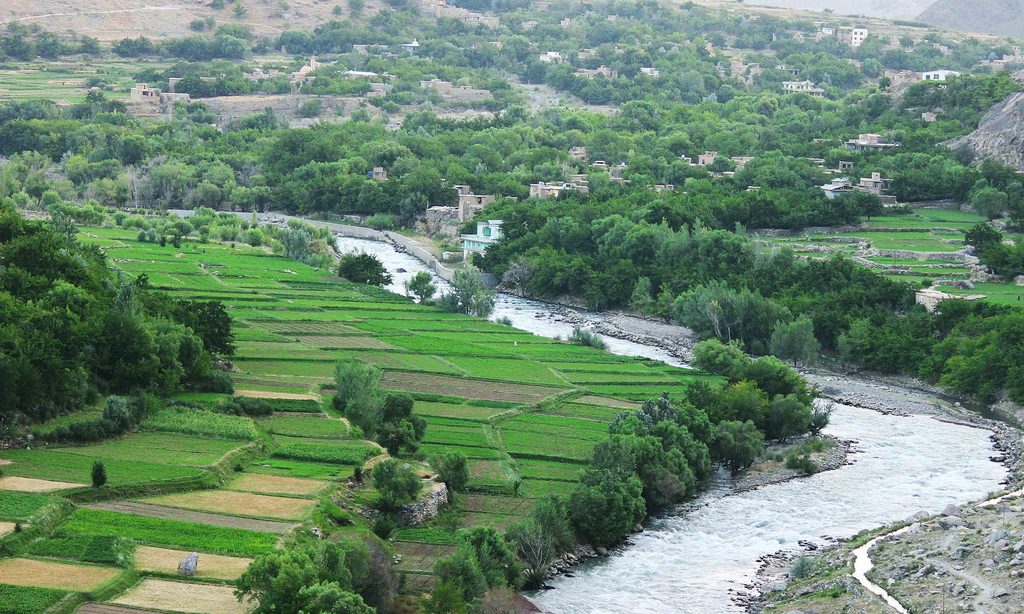
Panjshir River, © Wikipedia

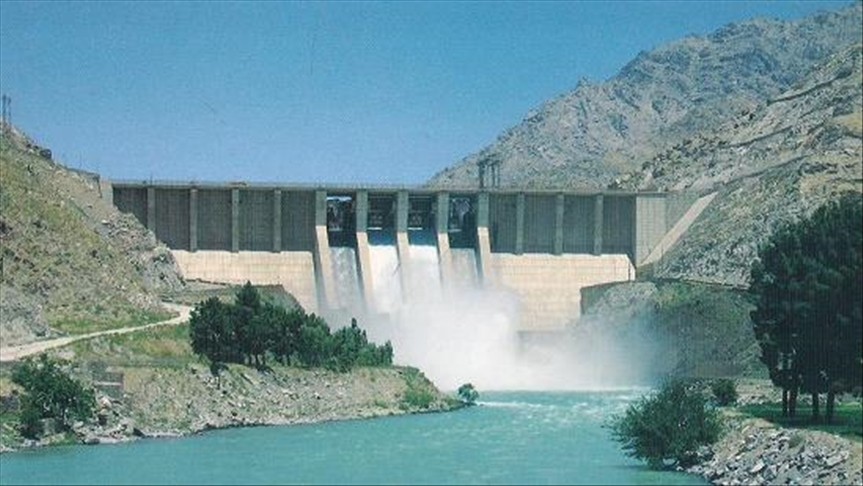
Shahtoot Dam, © AA
Equally critical is groundwater management. The city must impose strict limits on new wells and enforce metering—otherwise every wealthy resident will simply drill deeper, leaving the poor or two million at risk with nothing. As per a UN report, nearly half of borewells in Kabul are dry, while others are functioning at only 60 percent efficiency. NWAEA and Kabul Municipality should crack down on illegal boreholes and profiteering water tankers. There should be incentives for aquifer recharge: for example, capturing rainwater runoff or treated wastewater and funneling it into underground basins to rebuild reserves. (Modern recharge techniques—used successfully in places like India and Australia—can recharge millions of cubic meters each year if planned properly). Also, upgrading and maintaining the piped network (fixing leaks, replacing aging pipes) will reduce waste. Conservation must become a citywide priority: public campaigns to fix household leaks, reuse greywater (for irrigation), and even modest rationing can extend the dwindling supply. In Cape Town’s 2018 crisis, for instance, mandatory rationing and aggressive public messaging staved off “day ”zero”—lessons Kabul ignores at its peril.
Concrete steps forward might include:
Expedite strategic infrastructure. Allocate emergency funds and foreign assistance to finish the Shahtoot Dam and Panjshir pipeline projects; these will diversify Kabul’s water sources beyond the fragile borewell.
Regulate groundwater use. Institute strict permitting, registration, and metering of all new wells, and ban unauthorized drilling. Enforce penalties for illegal well operators and overhaul water pricing to discourage waste.
Enhance aquifer recharge. Invest in low-cost rainwater harvesting and managed recharge schemes (e.g., recharge basins and treated wastewater injection) to rebuild groundwater stores. Repair and expand reservoirs like Qargha to capture seasonal flows.
Mobilize the community. An education campaign should be launched promoting water-saving habits (shorter showers, fixing leaks, reusing water) and involving mosques/masjids, schools, and volunteers in conservation. Distribute simple technology like greywater filters and efficient fixtures to households.
Strengthen institutions and financing. UN agencies and donors should unfreeze and increase WASH funding, with strict oversight, to back these projects. MoWE and NWARA need technical support to plan and regulate; Kabul’s municipality should institute transparent budgeting for water. Above all, coordination among city, provincial, and national water authorities must be drastically improved.
The humanitarian stakes are high. An unprecedented crisis looms if no bold action is taken. “Kabul’s water crisis represents a failure of governance, humanitarian coordination, water regulation, and infrastructure planning,” notes the Mercy Corps report on KABUL’S WATER CRISIS—adding that without massive efforts, “the city faces an unprecedented humanitarian disaster within the coming decade.” In practical terms, this translates to children facing thirst, hospitals potentially shutting down, and a significant outflow of people from the capital. Additionally, this situation threatens to worsen instability, as water scarcity has historically been a catalyst for conflict in Afghanistan.
This is a call to action, not to disappear. Kabul leaders—from the municipality to relevant ministries and directorates—must treat water as the emergency it is. They must enforce regulations, crack down on corruption, and partner with engineers, communities, and donors to turn the tide. At the same time, every citizen should conserve water as if life depends on it—because it does. Only through immediate, coordinated efforts can Kabul avoid the calamity of running dry.
About the author:
Elham Kabir is a development professional with over a decade of experience in multiple sectors. He has led multi-million dollar humanitarian and infrastructure projects across afghanistan, working closely with INGOS, private sector and government bodies.