
Introduction
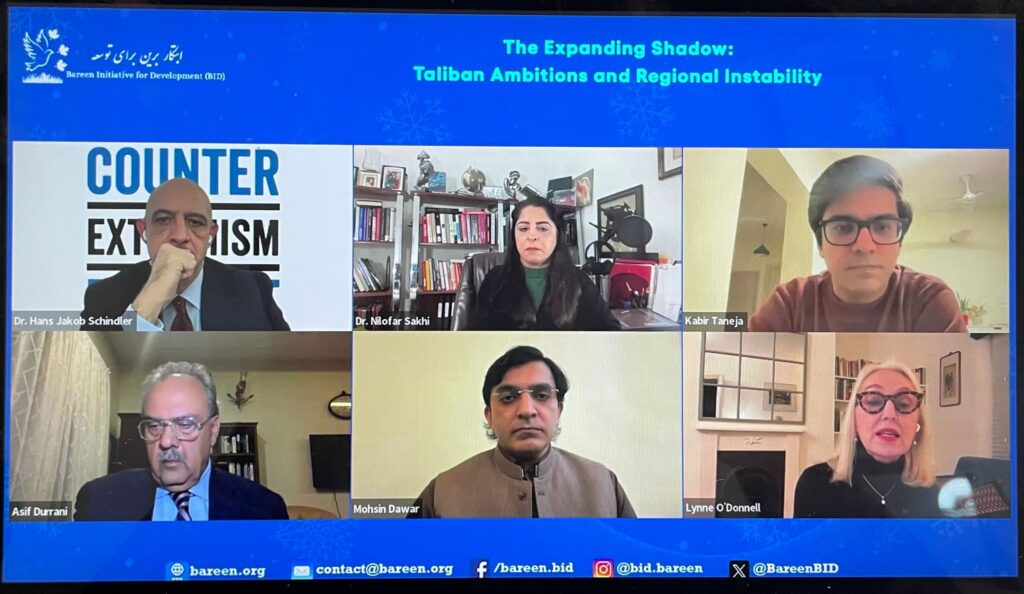
On Saturday, 22 November 2025, A significant webinar titled “The Expanding Shadow: Taliban Ambitions and Regional Instability” was hosted by the Bareen Initiative for Development (BID). The event aimed to examine Afghanistan’s evolving political and security landscape, its regional implications, and the complex pathways forward to stability and engagement. The discussion centered on Afghanistan more than four years after the Taliban’s return to power in August 2021, addressing security concerns, human rights, economic sustainability, and the challenges to regional cohesion.
Program Details
The international webinar, moderated by Lynne O’Donnell, provided a platform for an in depth, multifaceted discussion on Afghanistan’s current challenges and opportunities. The event facilitated the sharing of unique perspectives from distinguished guests on Afghanistan’s governance, security, and regional dynamics.
Host and Speakers
The panel featured a host and five distinguished guests, introduced in the following order:
- Lynne O’Donnell, Journalist Moderated the panel discussion.
- Dr. Nilofar Sakhi, Associate Research Professor of International Affairs, George Washington University, President, Andiana Foundation,
- Mohsin Dawar, Former Pakistani parliamentarian & President, National Democratic
Movement
- Dr. Hans Schindler, Senior Director of the Counter Extremism Project
- Kabir Taneja, Deputy Director and Middle East Fellow, Strategic Studies Programme, Observer Research Foundation, India.
- Asif Durrani, Pakistan’s former Special Representative on Afghanistan.
Panel Discussion: Key Findings
The panel explored how Afghanistan’s internal dynamics and the Taliban’s rule are shaping regional security and policies.
The Existential Threat of the Taliban and Militant Networks
- Dr. Nilofar Sakhi, characterized the Taliban as an existential threat to Afghanistan’s future and regional stability. Her main points included:
- Transnational Ties: The Taliban maintains strong, long-standing links with transnational militant groups, including al-Qaeda, Central Asian militant groups (Uzbekistan, Tajikistan), and fundamentalist groups in Bangladesh.
- TTP Connectivity: There is a very strong connection with the Tehrik-i-Taliban Pakistan (TTP), described as ideological, transactional (money and business), and bonded by family ties. The surge in TTP attacks in Pakistan since the Taliban takeover demonstrates their inspiration and support.
- Escalating Regional Instability: The Taliban’s rule has led to instability evidenced by cross border clashes (Uzbekistan and Iran over water, Tajikistan over trade/transit) and the presence of groups like Jamaat-e-Ansarullah in the north.
- Resurgence of ISKP: The Taliban’s return motivated the Islamic State Khorasan Province (ISKP) to reorganize and conduct attacks across the region (Iran, Moscow, Afghanistan).
- Radicalization: The establishment of numerous new madrasas, sometimes supported by external entities like Saudi Arabia, promotes extremism and creates an open space for jihadi recruitment, which will have a disastrous, long term impact on security.
Pakistan’s Policy and Regional Fallout
- Mohsin Dawar: focused on the consequences of Pakistan’s long standing strategy:
- Strategic Miscalculation: He argued that in search of “strategic depth” in Afghanistan, Pakistan has effectively handed over a strategic depth to the Taliban in Pakistan.
- TTP Control: Local militant groups, including the TTP, have flourished under the Afghan Taliban’s umbrella and now have de facto control in much of Khaybar Pakhtunkhwa.
- Recruitment Environment: The closure of the border and the high volume of refugee expulsions have created joblessness and a “friendly environment for recruitment” for militants.
- No Chance for Peace: He concluded that as long as the Taliban remains in power, there is no chance for peace in the entire region.
- Asif Durrani: The Realist’s Assessment of Taliban Governance and Regional Security/Economic Fallout:
- Taliban’s Status: A Political Reality: Must approach the Taliban as “a reality” and “a business in the town,” despite general frustration with their regime.
- Immediate Security Challenge: The main immediate issue is the surge in terrorist attacks and the pressing need for effective control over them.
- Trade as a Political/Economic Tool: Trade has been used as a tool and has been stopped since October between Pakistan and Afghanistan.
- Humanitarian Impact of Trade Stoppage: The cessation of trade is causing millions of dollars of losses to Afghan traders and “immense losses to the people, normal people,” severely exacerbating abject poverty in Afghanistan.
- Afghanistan’s Economic Character: Characterized Afghanistan as a “center of war economy,” which negatively and equally impacts Pakistan’s provinces of Balochistan and Khaybar Pakhtunkhwa (KP).
- Taliban’s Governance Failure: Agreed that there is “no good news” and that the Taliban have “failed to deliver.” This failure, while concerning, was suggested to be a potential source of optimism.
- Weakness of Internal Opposition: Tempered any optimism by noting that the internal opposition to the Taliban is “not united enough,” “not organized enough,” and “not coherent”, leading to a lack of much optimism.
Other Key Observations
- Global Terror: Hans Schindler noted a global trend of consolidating Islamist extremist groups across Africa and the Middle East, all drawing on the “victory narrative” that traces back to the fall of the Afghan Republic. He warned that Islamist international terrorism is back and that the lack of political will to address this issue will have well known, negative results.
- Exploiting Discrepancies: Kabir Taneja highlighted that the lack of a US/NATO security umbrella has forced regional countries to engage individually, which gives the Taliban an opportunity to play the region by leveraging geopolitical discrepancies and security requirements to serve their own interests.
- Taliban’s Leverage: Dr. Nilofar Sakhi noted that the Taliban uses its connection with terror groups as leverage in negotiations with regional countries, talking from a “position of power” rather than interest.
Proposed Strategies and Conclusion: Practical Pathways for Change
The core challenge remains that the Taliban are not a rational actor and will not willingly give up their ties to militant groups. Current platforms for regional engagement, such as the SCO and Moscow format, have failed to produce concrete outcomes.
The consensus among the panelists recommendations points toward a combination of internal and external pressure:
- Regional Consensus: There is a need for a unified regional mechanism to create a consensus based approach, as the current country based opportunistic strategy only benefits the Taliban.
- Internal Political Process: An internal political process must be initiated within Afghanistan to reshape the future government, which is necessary for long term stability and security that will extend beyond the borders.
Conclusion: The Need for Multidimensional and Coordinated Action
The discussions underscored the grave and complex nature of the crisis emanating from Afghanistan. Addressing the security and governance threats posed by the Taliban requires a simultaneous, multidimensional approach. The lack of a collective decision or a coherent regional strategy will ultimately serve the Taliban’s purpose and shape a negative trajectory for the region for a long time to come.
Concept Note English
Concept Note Persian
English Report:
Persian Report: